Un progetto dedicato alla memoria di mio padre e ai suoi bellissimi giardinetti. A project dedicated to the memory of my father and to his beautiful gardens
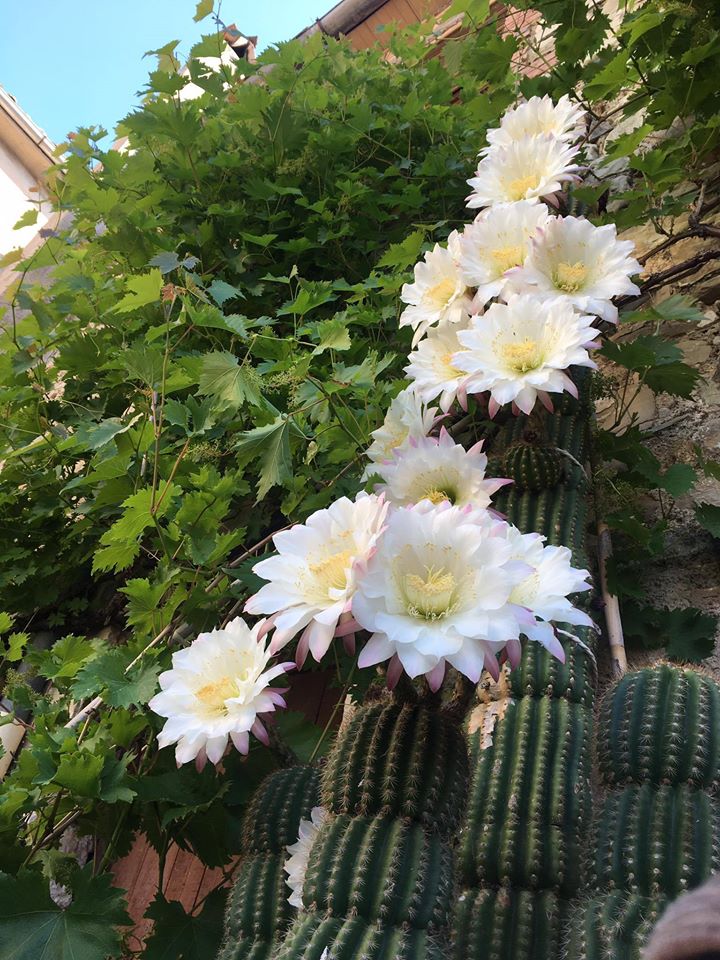
Il cactus fiorito di mio padre / My father’s cactus in bloom. – foto: Leo Colalillo
English follows –
In queste ultime settimane ho trovato molto conforto nel disegnare visto che la lucidità per esprimermi in parole mi mancava.
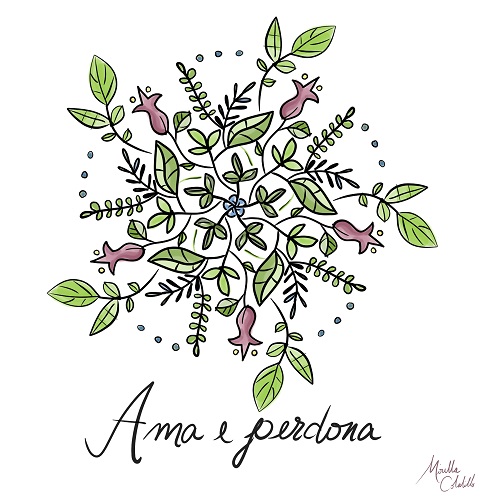
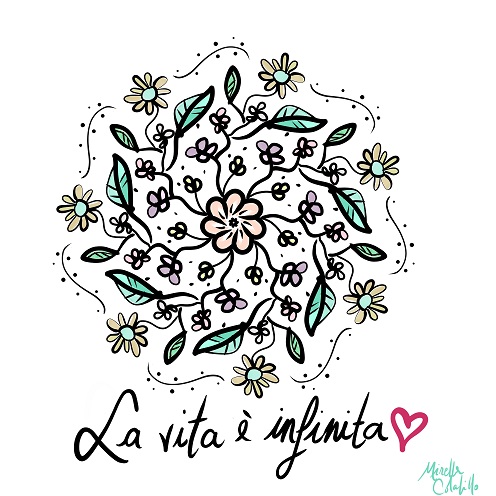
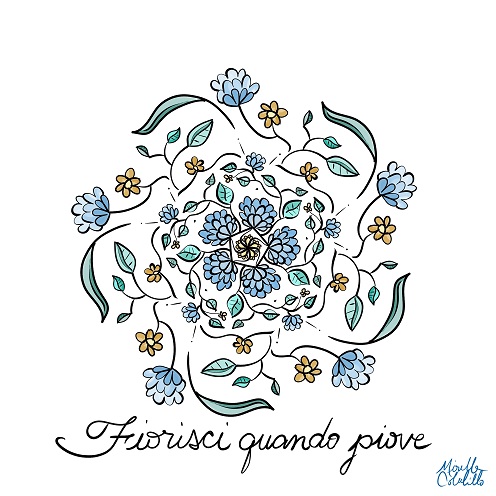
Per alcuni dei miei disegni mi sono ispirata ai giardinetti di mio padre che quest’anno, la prima estate senza di lui, sono fioriti da soli in tutto il loro splendore. Ho disegnato dei mandala fioriti.
Pare che l’Italia si stia rialzando e tra un mese finalmente sarò lì. Spero che potrò dire che dopo quest’apocalisse le cose cambieranno finalmente per il meglio nel bel paese. Chi vivrà vedrà.
Nel frattempo continuerò a disegnare mandala e a trovare ispirazione nei fiori.
In the last few weeks I have found a lot of comfort in drawing since I was missing the clarity to express myself in words. For some of my drawings I was inspired by my father’s gardens ”giardinetti” which this year, the first summer without him, have bloomed alone in all their splendor. I designed flowery mandalas. It seems that Italy is getting back up and in a month I will finally be there.
I hope I can say that after this apocalypse things will finally change for the better in the beautiful country ”bel paese”. Time will tell.
In the meantime, I will continue to draw mandalas and to find inspiration in flowers.
Con affetto, Mirella
Altri articoli da leggere / More articles to read:
10 ideas for studying Italian in the summer or on vacation
Ci sono così tante alternative per praticare l’italiano in modo divertente. Cucinare, leggere, ascoltare musica. Puoi trovare ispirazione da ciò che ti piace. Ti presento 10 idee!
There are so many alternatives to practice Italian in a fun way. Cooking, reading, listening to music. You can just find inspiration from what you enjoy. These are 10 ideas!
Si possono ascolare i podcast ovunque anche mentre si viaggia. Ormai esistono centinaia di podcast su qualsiasi argomento. La cosa bella è che l’esercizio di ascolto aiuta a migliorare la pronuncia e ad aumentare il vocabolario oltre a rendersi più informati.
You can listen to podcasts anywhere even while traveling. There are now hundreds of podcasts on any topic. The great thing is that listening exercises help improve pronunciation and increase vocabulary as well as make you more informed.
Leggere: un’attività che aiuta non solo a godersi un po’ di meritato riposo, ma anche a migliorare la lingua e ad approfondire le conoscenze culturali dell’Italia.
Reading: an activity that helps not only to enjoy some well-deserved rest, but also to improve the language and deepen the cultural knowledge of Italy.
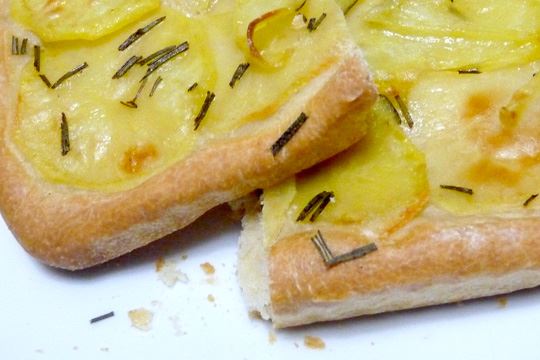
E ancora cibo!! Amo la pizza di patate. Conosci la canzone napoletana ‘A pizza’ di Giorgio Gaber? “Ma tu vuliv’a’pizza a’pizza a’pizza”… Pausa musicale: https://www.youtube.com/watch?v=eoIl5-2fYTo
And more food !! I love potato pizza. Do you know the Neapolitan song ‘A pizza’ by Giorgio Gaber:? “Ma tu vuliv’a’pizza a’pizza a’pizza … Music pause.
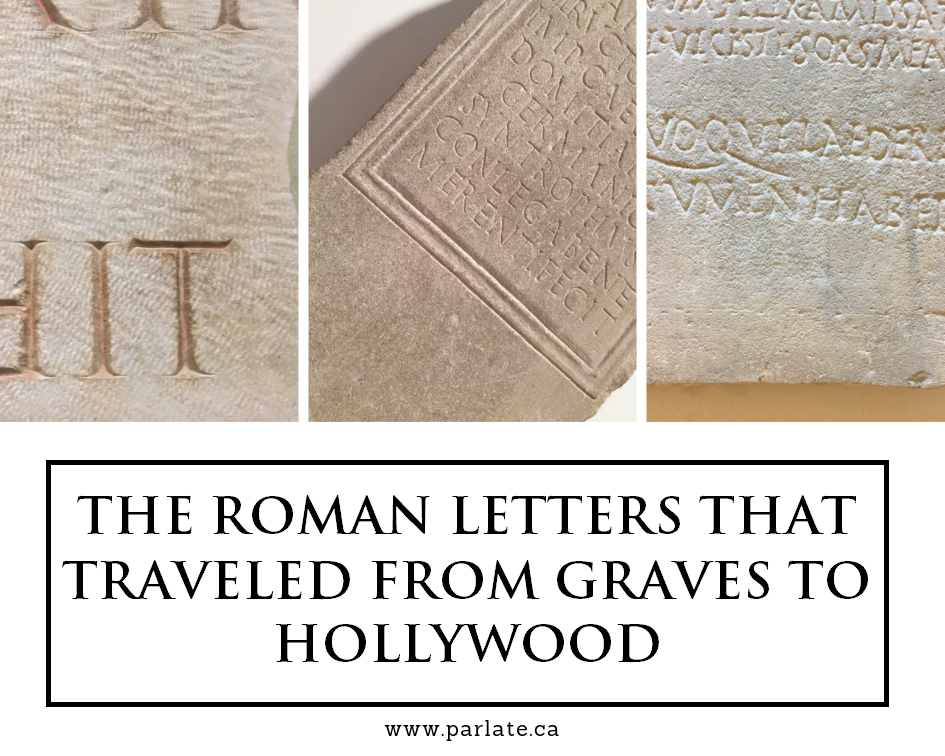
Quando viaggiamo in Italia troviamo molte scritte romane, che a volte non capiamo. Neanch’io che ho studiato il latino a scuola! Sai che una tipologia di lettera in particolare è molto usata nel cinema.
When we travel in Italy we find many Roman writings, which we sometimes don’t understand. I don’t either even though I studied Latin at school! Did you know that a particular type of letter is widely used in cinema.
Did you know that in Italian there’s la font (feminine) and il font (masculine)? Me neither! La font represents the name of the font, while il font is the technical file with all the typographic variations of la font … my brother, an expert in the field, explained it to me and talks to us here about a particular font, the Trajan.
Lo sapevi che in italiano esiste la font (femminile) e il font (maschile)? Neanch’io! La font rappresenta il nome del carattere, mentre il font è il file tecnico con tutte le variazioni tipografiche della fonte…me lo ha spiegato mio fratello, esperto del mestiere, che qui ci parla di una font in particolare, il Trajan.
Did you know that in Italian there’s la font (feminine) and il font (masculine)? Me neither! La font represents the name of the font, while il font is the technical file with all the typographic variations of la font … my brother, an expert in the field, explained it to me and talks to us here about a particular font, the Trajan.
“Cos’è un carattere (font)? Fino a qualche decennio fa era un argomento per soli addetti al settore, ma con il computer le cose sono cambiate, di punto in bianco chiunque poteva e doveva scegliere una font con cui scrivere il suo documento, Arial, Times New Roman? Negli anni questa scelta è aumentata esponenzialmente fino ai giorni nostri, in cui tramite i social network usare una font non è solo un’esigenza ma uno strumento per esprimersi.
What’s a character (font)? Until a few decades ago it was a subject for industry professionals only, but with the computer, things changed, anyone could and had to choose a font with which to write their document, Arial, Times New Roman? Over the years, this choice has increased exponentially to the present day, in which through social networks using a font is not just a need but a tool for self-expression.
Ma voglio parlarvi di una font in particolare, il Trajan, che probabilmente non avrete usato nei vostri documenti, a meno che non siate dei grafici o non facciate comunicazione.
But I want to talk to you about a particular font, the Trajan, which you probably will not have used in your documents, unless you are a graphic designer or work in communication.
Voglio parlarvene, perché molto probabilmente a vostra insaputa l’avete vista mille volte, ad esempio al cinema, tanto da essere stata ribattezzata The Movie Font. Infatti è stata usata in film come Io sono Legenda, Unbreakable, L’Ultimo Samurai, A Beautiful Mind, The Gladiator. Il grafico Yves Peters dice che sono più di 400 i poster realizzati con questa font.
Ma veniamo al dunque.
I want to talk to you about it, because most probably you’ve seen it a thousand times before, for example at the cinema, so much so that it was renamed The Movie Font. In fact it was used in films like “I’m Legend”, “Unbreakable”, “The Last Samurai”, “A Beautiful Mind”, “The Gladiator”. The graphic designer Yves Peters says that there are more than 400 posters made with this font.
But let’s get to the point.
Se per molti Poster cinematografici il Trajan è una scelta azzeccata, per altri un po’ meno e nel caso di Artificial Intelligence totalmente errata. Per capirlo scopriamo com’è nato il Trajan
If for many movie posters Trajan is a good choice, for others a little less, and in the case of Artificial Intelligence, it’s totally wrong. To understand this let’s discover what Trajan is and how it was born.
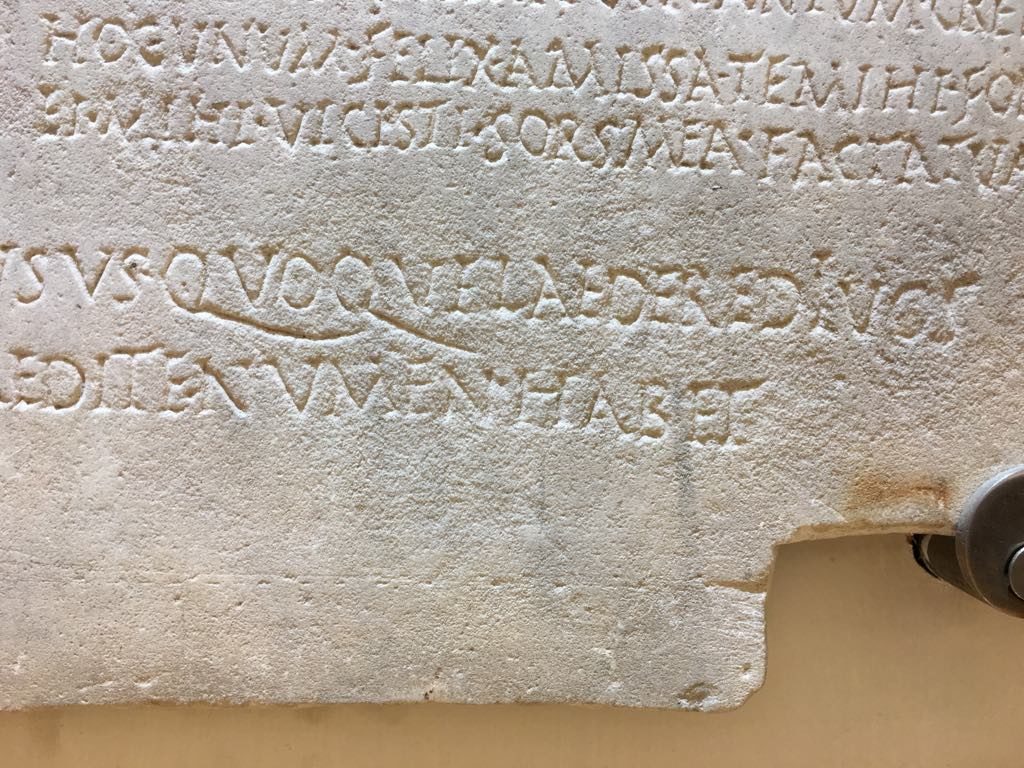
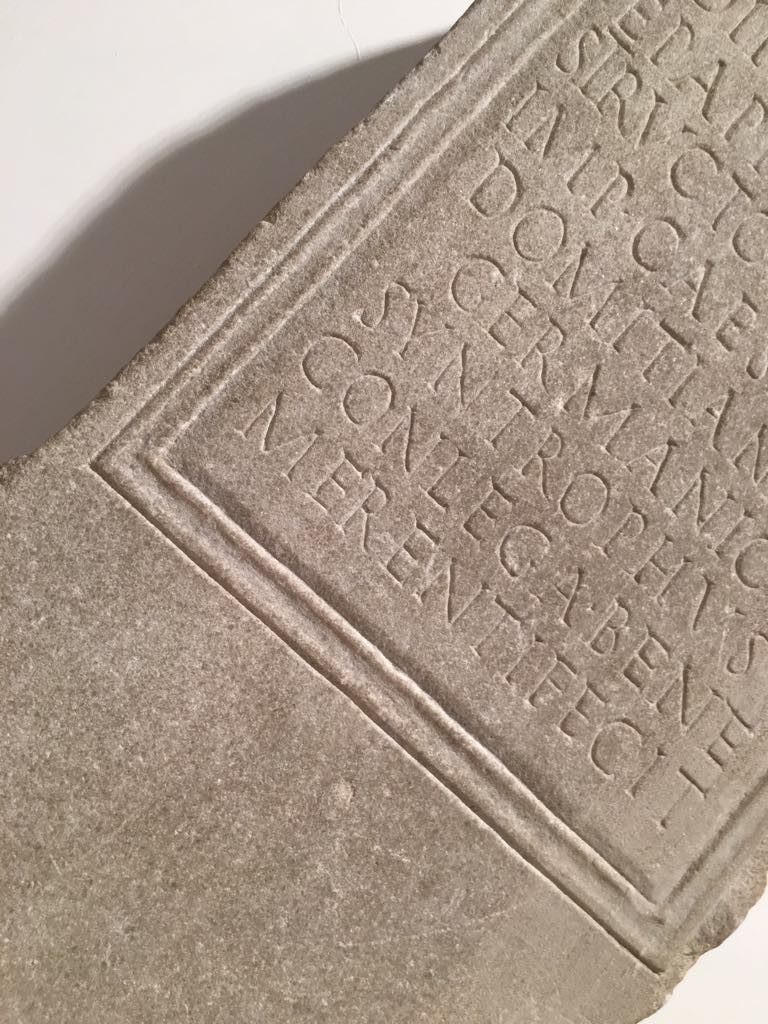
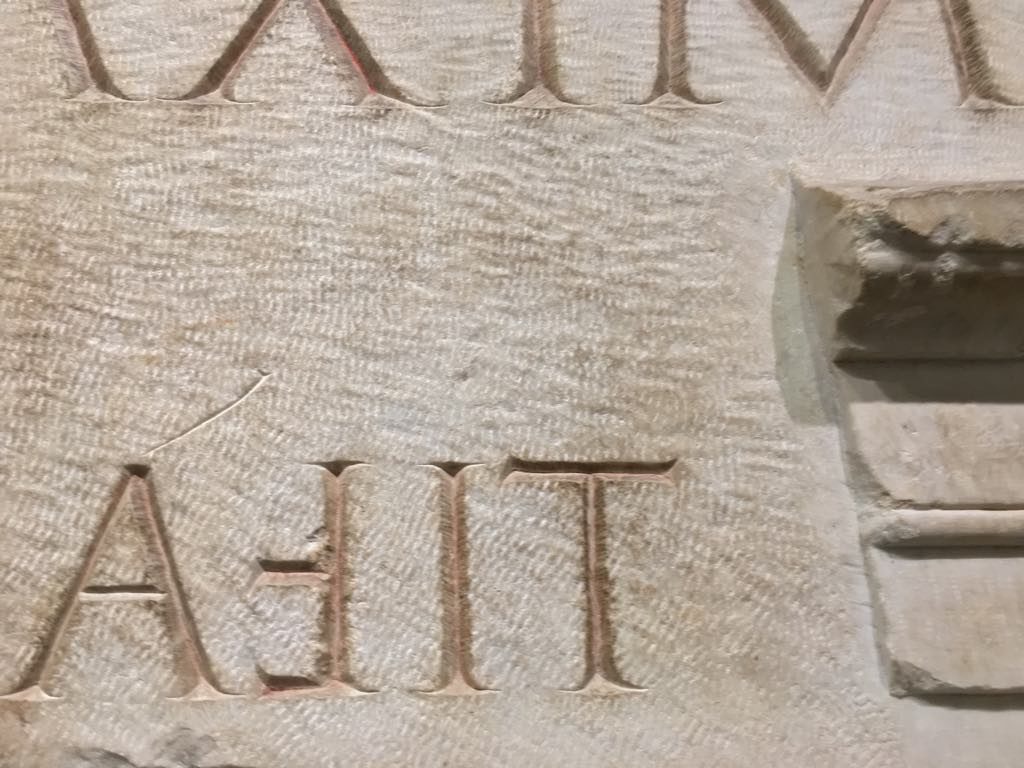
Alla fine degli anni ’80 la designer Carol Twombly studia i caratteri lapidari romani, quindi la scrittura in uso durante l’impero romano e se andate a Roma la città ne è piena, tutti i templi, le tombe e luoghi più importanti hanno incisioni su pietra realizzati secondo questo stile. Carol nei suoi studi si concentra prevalentemente sulle incisioni alla base della Colonna di Traiano e ne viene fuori un carattere classico ed elegante che dopo quasi trent’anni resta uno dei caratteri più utilizzati nel mondo della comunicazione visiva.
At the end of the 80s the designer Carol Twombly studied the Roman lapidary characters, then the writing in use during the Roman Empire and if you go to Rome the city is full of it, all the temples, the graves and most important places have engravings on stone made according to this style. In her studies Carol focuses mainly on the engravings at the base of the Trajan’s Column and what emerges is a classic and elegant character that after almost thirty years remains one of the most used characters in the world of visual communication.
Date le sue origini si capisce che il Trajan si presta benissimo per realizzare poster come quello de Il Gladiatore, ambientato in epoca romana e quindi perfettamente in linea con lo stile romano della font, al contrario di Artificial Intelligence in cui l’utilizzo è incoerente con l’argomento trattato. La prossima volta che vedrete un poster cinematografico fate caso a che carattere hanno utilizzato, magari è proprio un Trajan.
Given its origins it’s understood that the Trajan lends itself beautifully to create posters such as that of “The Gladiator”, set in Roman times and therefore perfectly in line with the Roman style of the font, as opposed to “Artificial Intelligence” in which its use is inconsistent with the topic covered. The next time you see a movie poster, notice what character they used, maybe it’s a Trajan.”
Leo Colalillo è un designer grafico laureato con la Lode all’Istituto Europeo del Design di Roma. Lavora tra Roma e Milano. I suoi lavori si trovano su MyFonts e sono pubblicati su Typodarium (2016, 2017, 2019). Web: http://leocolalillo.com/
Leo Colalillo is a graphic designer graduating with honors at the European Institute of Design in Rome. He works between Rome and Milan. His works can be found on MyFonts and are published on Typodarium (2016, 2017, 2019). Web: http://leocolalillo.com/
Written by Janine C. Funk / Scritto da Janine C. Funk
Article edited by Mirella. For simplicity we used passato prossimo instead of passato remoto
The History of Italian Culture / La Storia della Cultura Italiana
Part 1: The Etruscans / Capitolo I: Gli Etruschi
When you think of Italy, you probably think of Rome, the ancient heart of the Classical world and the center of one of history’s most esteemed empires. With 7.3 million international visitors in 2017, the city remains a top tourist destination and cultural landmark. But before the Colosseum and the Forum, before the Pantheon and the Arch of Constantine, when Rome was just a small collection of pastoral settlements whose names have been long lost to history, Italy belonged to the Etruscans.
Quando pensi all’Italia, pensi probabilmente a Roma, il cuore antico del mondo Classico ed il centro di uno degli imperi più stimati della storia. Con 7,3 milioni di turisti internazionali nel 2017, la città rimane una destinazione superlativa e una pietra miliare della cultura. Però, prima del Colosseo e del Foro, prima del Pantheon e del Arco di Constantino, quando Roma era solo un piccolo gruppo di cittadine pastorali i cui nomi si perdono nella storia, l’Italia ha appartenuto agli Etruschi.
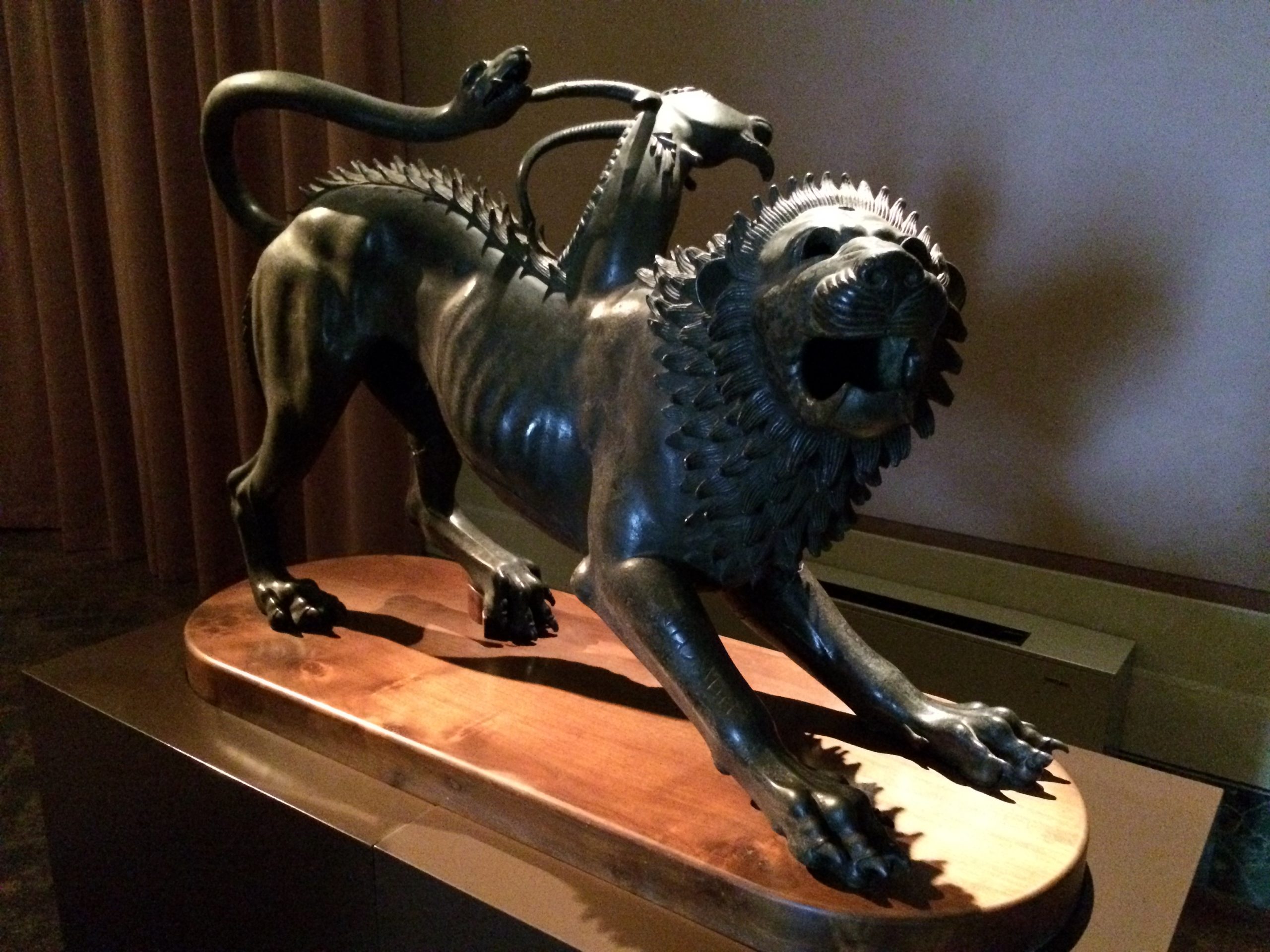
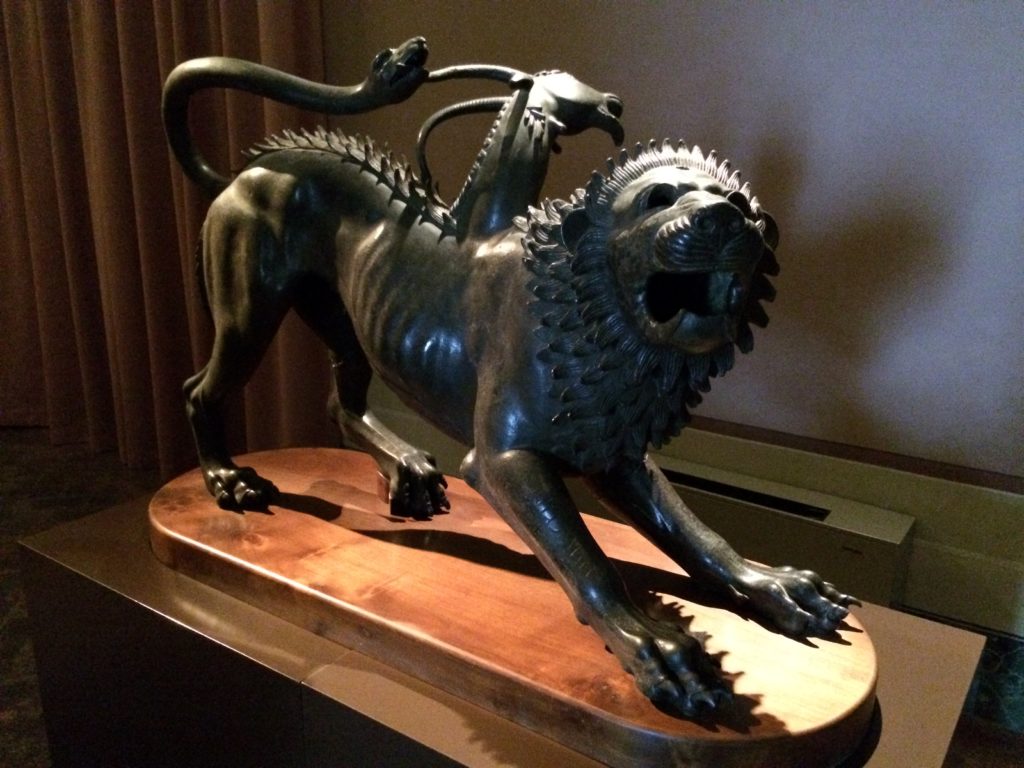
la Chimera d’Arezzo, ca. 375-350 a.C., Firenze, Museo dell’Archaeologia
The Etruscans were a group of indigenous peoples that inhabited the area of central Italy between the Arno river, which passes through Florence and Pisa, and the Tiber river, which flows through Rome, from at least the eleventh to the first century B.C.E.. Their political and cultural influence, however, reached far beyond the borders of Etruria – today, accounting for parts of Tuscany, Lazio and Umbria – across both space and time. Due to their significant impact on the development of modern Italian culture, including the adoption and adaptation of the Greek alphabet, mythology and art, the Etruscans are considered to be “… the most important of the indigenous peoples of pre-Roman Italy…”
Gli etruschi erano un gruppo di persone indigene che abitavano l’area dell’Italia centrale tra il fiume Arno, che attraversa Firenze e Pisa, e il fiume Tevere, che attraversa Roma, almeno dall’undicesimo secolo al primo secolo a.C. Però, l’influenza politica e culturale degli Etruschi si estendeva lontana oltre i confini di Etruria – oggi, include parte della Toscana, del Lazio e dell’Umbria – attraversando spazio e tempo. A causa del loro significativo impatto sull’evoluzione della cultura Italiana moderna, compresa l’adozione e la modificazione dell’alfabeto, della mitologia e dell’arte dei greci, gli etruschi sono considerati “…la più importante popolazione indigena dell’Italia prima dei romani…”
The Etruscans are particularly famous for their artistic achievements. Beginning in the late eighth century B.C.E., Etruscan art was heavily influenced by their Aegean and Levantine trading partners, which introduced new materials, techniques, and iconography such as “…the human figure, real and fantastic beasts (especially the lion), and vegetal and geometric motifs…” It is during this era, referred to as the Orientalizing period (late 8th – early 6th centuries B.C.E.), that the art forms for which the Etruscans are most celebrated – bronze work, pottery, sculpture, and wall paintings – emerged.
In particolare, gli etruschi sono famosi per le loro realizzazioni artistiche. Iniziando nell’ottavo secolo a.C., l’arte etrusca è stata molto influenzata dai loro compagni di commercio Egei e Levantini, che hanno introdotto nuovi materiali, nuove tecniche, e nuove iconografie come “…la figura umana, le bestie reali e fantastiche (specialmente il leone), e motivi vegetali e geometrici…”. Durante quest’epoca, che si chiama il periodo dell’Orientalizzazione (dalla fine dell’ottavo secolo fino all’inizio del sesto secolo a.C.), sono nate le forme di arte per cui gli Etruschi sono più celebri: la bronzistica, la ceramica, la scultura, e l’imbiancatura.
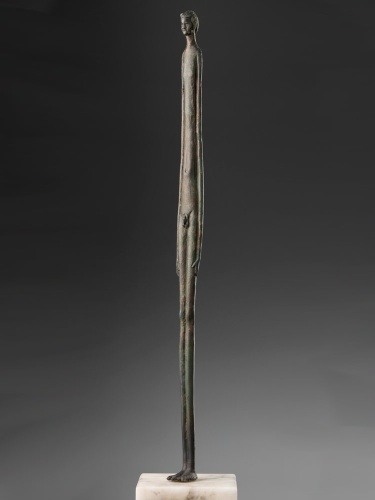
Thanks to rich local metal deposits, and contact with traders from Greece and the eastern Mediterranean, Etruscan production of bronze goods flourished. Even in antiquity, northern Etruscan cities were well known for their abilities to shape bronze into beautifully engraved hand-held mirrors, which were often decorated with scenes from Greek mythology, and votive statuettes, which were presented as offerings at sanctuaries and other sacred sites. However, it was not until the Classical period (c. 480-300 B.C.E.) that large-scale hollow-cast masterpieces – including perhaps the most famous Etruscan bronze, the Chimera of Arezzo (c. 375-350 B.C.E., Florence, Museum of Archaeology) – appeared. The curious elongated bronze figures of Volterra, including the Evening Shadow (c. 2nd century B.C.E., Volterra, Museo Etrusco Guarnacci), also began appearing during this era; these abstract votives would later inspire the early Italian tradition of board-like statuettes.
Grazie a depositi ricchi di metallo e il contatto con i mercanti della Grecia e del Mediterraneo orientale, la produzione delle merci di bronzo prosperava. In antichità, le città etrusche del nord erano famose per le loro abilità di plasmare bellissimi specchi incisi che ornavano spesso con scene della mitologia greca, e le statuine votive che offrivano ai santuari e ad altri luoghi sacri. Comunque, capolavori più grandi – come il bronzo etrusco più famoso, la Chimera d’Arezzo (c. 375-350 a.C., Firenze, Museo dell’Archaeologia) – non sono apparsi prima del periodo Classico (c. 480-300 a.C.). Durante quest’era, le curiose statuette allungate di Volterra, come l’Ombra della Sera (c. 200 a.C., Volterra, Museo Etrusco Guarnacci), hanno iniziato anche ad apparire; queste votive astratte hanno in seguito ispirato una tradizione italiana delle statuette schiacciate.
L’Ombra della Sera, ca. 200 a.C., Volterra, Museo Etrusco Guarnacci
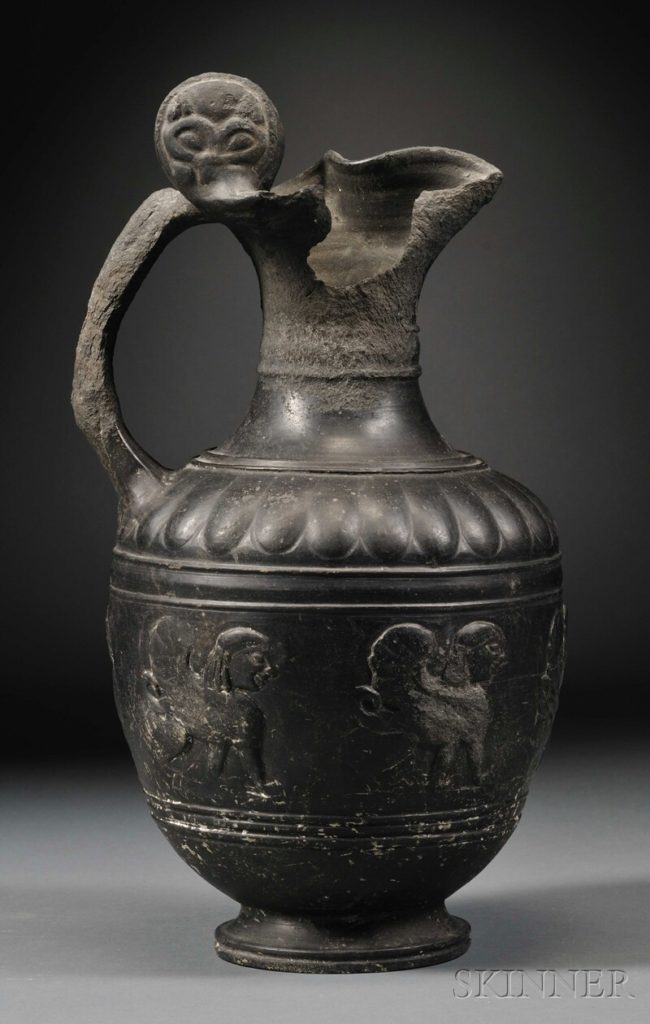
Bucchero, or “grey ware”, was developed in Ceveteri, as early as 675 B.C.E., and exported as far as Iberia and the Levant. This pottery was esteemed for its glossy dark grey to black finish, caused by the oxidation of the clay’s reddish ferric oxide while in the kiln. The forms that bucchero took are believed to have been inspired by both Greek pottery styles and contemporary metalwork, especially bronze. In addition to commonplace items like bowls, cups and jugs, bucchero was also shaped into cleverly designed vessels resembling animals, such as the cockerel of Viterbo. Most bucchero vessels were not decorated, but those that were embellished were incised or embossed with simple lines, geometeric patterns, motifs, and scenes from Greek mythology; some bucchero, in imitation of metalwork, were covered with gold or silver leaf, or with a thin layer of tin.
Bucchero si è sviluppato a Ceveteri circa 675 a.C., ed esportato fuori dell’Italia, alla penisola Iberica, al levante, e altre aree dell’Europa. Questa ceramica era pregiata per la sua lucida finitura nera, causata dell’ossidazione del rosso ossido ferrico nell’argilla. Le forme del bucchero s’ispiravano alle ceramice greche e ai metalli contemporanei, specialmente i bronzi. In aggiunta agli articoli usuali come le ciotole, le calici e le caraffe, bucchero veniva plasmato in recipienti ingegnosi che assomigliavano ad animali, come il galletto di Viterbo. La maggior parte del bucchero non è decorato, ma alcuni recipienti sono decorati con solchi semplici, disegni geometrichi, motivi, e scene di mitologia greca. Altri recipienti sono coperti con fogliame d’oro, di argento, o di latta per imitare i metalli.
Bucchero, Ceveteri, ca. 675 a.C
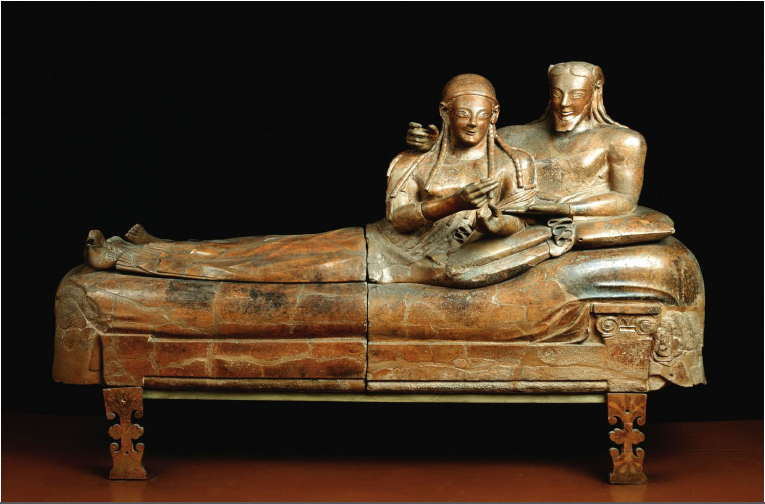
The Etruscans used sculpture primarily for funerary or religious purposes, including sarcophagi, ash urns and votive offerings made from terracotta, local stone such as alabaster, limestone, sandstone and tufa, and bronze. Beginning in the seventh century B.C.E., large stone and terracotta figures began appearing in tombs as either representations of tomb guardians, like those in the Tomb of Five Chairs in Cerveteri (c. 625-600 B.C.E.), or replacements for the bodies of the deceased, as seen in terracotta and bronze urns in Chiusi. Some painted terracottas, such as the Sarcophagus of the Spouses (c. 525-500 B.C.E., Rome, Villa Giulia Museum), offer some insight into the nature of everyday Etruscan life, as well as funerary rituals. The Sarcophagus of Spouses, which depicts a married couple reclining on a banqueting couch, once brightly coloured, suggests that Etruscan women were regarded with more significance than their Greek counterparts. In addition, the wineskin cushions upon which the couple lounges may be a reference to the sharing of wine, an important aspect of Etruscan funerary ritual; the woman also appears to be pouring something, perhaps perfume, into her husband’s palm, alluding to the offering of perfume, another essential element of the Etruscan funeral.
Gli etruschi usavano principalmente le sculture per scopi funerari o religiosi come i sarcofaghi, le urne e le offerte votive di terracotta, di pietra locale come alabastro, calcare, arenaria e tufo, e bronzo. Dal 700 a.C., grandi figure di pietra e terracotta cominiciavano ad apparire nelle tombe in veste di rappresentazioni dei guardiani delle tombe, come quelle nella Tomba di Cinque Sedie a Cerveteri (c. 625-600 a.C.), o come sostituzioni dei corpi dei defunti, come le urne di terracotta e bronzo a Chiusi. Qualche terracotta dipinta, come il Sarcofago degli Sposi (c. 525-500 a.C., Roma, Museo Villa Giulia), offre alcuni scorci della natura della vita ordinaria degli etruschi, e anche dei riti funerari. Il Sarcofago degli Sposi raffigura una coppia sposata su un divano banchetto, che suggerisce che le donne etrusche avevano maggiore importanza delle donne greche. Inoltre i cuscini [WINESKIN] sono probabilmente un riferimento alla condivisione di vino, che era un aspetto importante dei riti funerare. La donna sembra versare qualcosa, forse profumo, sul palmo della mano del marito; quest’azione allude all’offerta dei profumi, che era un’altra parte essenziale dei funerali etruschi.
Sarcofago degli Sposi, ca. 525-500 a.C., Roma, Museo Villa Giulia
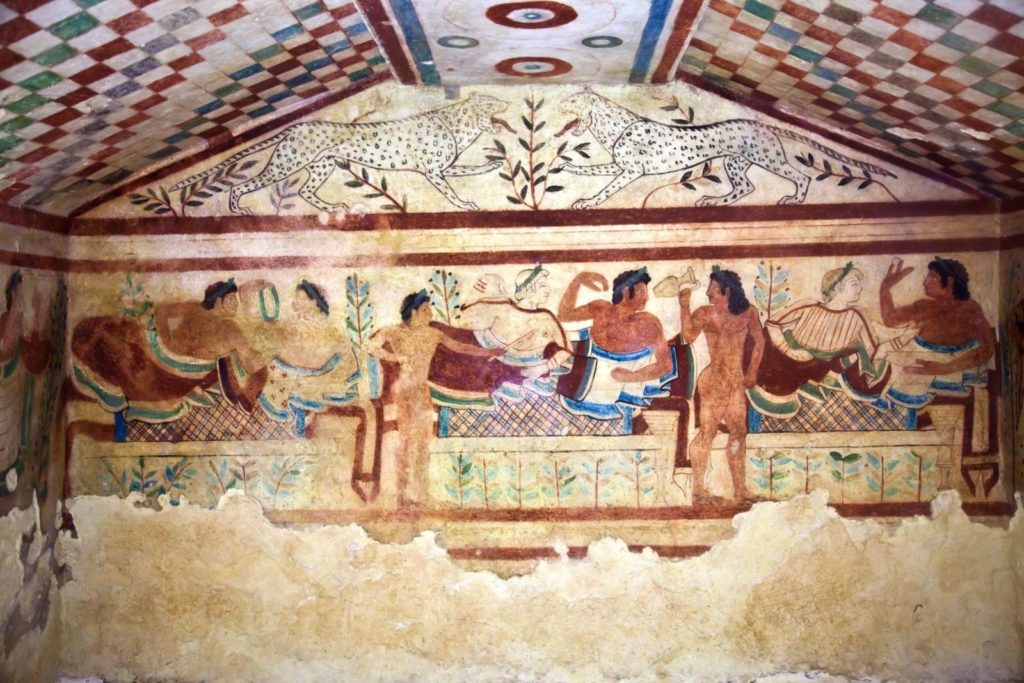
Many of the best examples of Etruscan painting were discovered in cemeteries, or necropoli, such as Monterozzi, near Tarquinia in Lazio, where huge works, depicting scenes of aristocratic life in Etruria, cover the interior walls of rock-cut chamber-tombs. One such tableau, found in the Tomb of the Lionesses in Monterozzi (c. 560 B.C.E.), illustrates a banquet, with dancers and musicians, and finely dressed nobles attended by naked servants. A second Monterozzi tomb painting, found in the Tomb of Hunting and Fishing (c. 510 B.C.E.), depicts a man hunting birds with what appears to be a slingshot, and a boat of fishermen casting a net. The murals of Monterozzi, along with a few other major centers, account for the largest surviving collection of wall paintings in the ancient world, outside of Egypt, Pompeii and Herculaneum.
Molti buoni esempi delle imbiancature etrusche sono state scoperte a necropoli, come Monterozzi vicino a Tarquinia nel Lazi, dove grandi imbiancature coprono le pareti delle tombe e mostrano scene della vita aristocratica in Etruria. Per esempio, un’imbiancatura nella Tomba delle Leonesse a Monterozzi (c. 560 a.C.) raffigura un banchetto con i ballerini, i musicisti, e i servi nudi che assistano gli aristocratichi. Una seconda imbiancatura a Monterozzi, nella Tomba della Caccia e della Pesca (c. 510 a.C.), raffigura un uomo che caccia gli uccelli con una fionda, e una barca con pescatori che gettano una rete. I murali di Monterozzi insieme a pochi altri centri importanti, sono considerati la più grande collezione di delle imbiancature del mondo antico fuori dall’Egitto, di Pompeii, e di Erculano.
Tomba delle Leonesse a Monterozzi, ca. 560 a.C.
When the Romans conquered the Etruscans in the late third century B.C.E., much of their culture disappeared as Etruscan nobles discarded their traditions for those of the dominant Greco-Roman society. However, the Etruscans also had a significant impact on Roman culture, as seen in the Roman adoption of Etruscan art, dress, music, and language. Today, the Etruscans survive in more than just museum collections; they survive in the artistic and cultural developments of their successors, and in the modern language that we know as Italian.
Quando i romani hanno conquistato gli etruschi nell’terzo secolo a.C., la maggior parte della loro cultura è morta, perché gli etruschi aristocratichi hanno abbandonato le loro tradizioni in favore di quelle della società greco-romana. Però, gli etruschi hanno avuto un’impatto significativo sulla cultura dei romani, che hanno adottato l’arte, i costumi, la musica e la lingua degli etruschi. Oggi, gli etruschi sono sopravvissuti non solo nelle collezioni dei musei; ma sono sopravvissuti negli sviluppi artistichi e culturali dei loro successori, e nella lingua moderna che conosciamo come la lingua italiana.
About the author:
Janine studies anthropology and history at university. She has a passion for the culture and the history of Italy, and she likes to share what she learns. He has been studying Italian with Mirella for several years. Some day she hopes to become a curator in a big museum in Europe, perhaps in beautiful Italy.
Janine studia antropologia e storia all’universita’. Ha una passione per la cultura e la storia d’Italia, e le piace condividere quello che impara. Studia l’Italiano con Mirella da parecchi anni. Qualche giorno spera diventare una curatrice in un museo grande in Europa, forse nella bella Italia.
Time for nougats, merry lights, and much deserved rest.
Magically here is also il Giornalino Natalizio (the Little Christmas Journal), a fun enrichment of the Italian language and culture even during the holidays.
In it you will find stories, quizzes, riddles, proverbs and more to enjoy a bit at a time or all in one breath.
You can browse the pages in company or alone, sipping a hot chocolate or mulled wine.
After a year of commitments and frenetic races, it’s nice to sit and breathe holding il Giornalino Natalizio and not think about anything!
Mi è giunta la notizia di tre racconti vagabondi quest’estate…per la precisione sono racconti scritti da tre autori italiani superlativi che hanno segnato la storia della letteratura italiana del XX secolo.
A questo punto ti starai chiedendo: “Ma chi saranno questi tre?” E va be’, te lo rivelo! Sono Natalia Ginzburg, Gianni Rodari e Italo Svevo. Tre autori diversi tra di loro sia per genere letterario che per stile di scrittura.
Scopri alcune chicche su di loro facendo questo quiz:
Quanto conosci questi 3 autori italiani?
Time limit: 0
Quiz-summary
0 of 7 questions completed
Questions:
1
2
3
4
5
6
7
Information
Pronti? Via!
You have already completed the quiz before. Hence you can not start it again.
Quiz is loading...
You must sign in or sign up to start the quiz.
You have to finish following quiz, to start this quiz:
Results
0 of 7 questions answered correctly
Your time:
Time has elapsed
You have reached 0 of 0 points, (0)
Average score
Your score
Categories
Not categorized0%
Congratulazioni!
Entra nel Circolo Letterario Italiano dell’Estate.
Quale di questi autori italiani è di origini ebraiche?
Correct
Incorrect
Question 4 of 7
4. Question
1 points
Natalia Ginzburg è nata a…
Correct
Incorrect
Question 5 of 7
5. Question
1 points
Quali di questi libri non è stato scritto da Italo Svevo?
Correct
Incorrect
Question 6 of 7
6. Question
1 points
Gianni Rodari diceva che con un po’ di esercizio è possibile prendere lezioni di ottimismo anche da
Correct
Incorrect
Question 7 of 7
7. Question
1 points
Era anti-fascista e nel 1983 viene eletto/a nelle liste del Partito Comunista Italiano al Parlamento
Correct
Incorrect
«Andrà lontano? Farà fortuna? Raddrizzerà tutte le cose storte di questo mondo? Noi non lo sappiamo, perché egli sta ancora marciando con il coraggio e la decisione del primo giorno. Possiamo solo augurargli, di tutto cuore: – Buon viaggio!»
(Gianni Rodari, Il giovane gambero, da “Favole al telefono”)
Alla salute e alla lettura!
Mirella
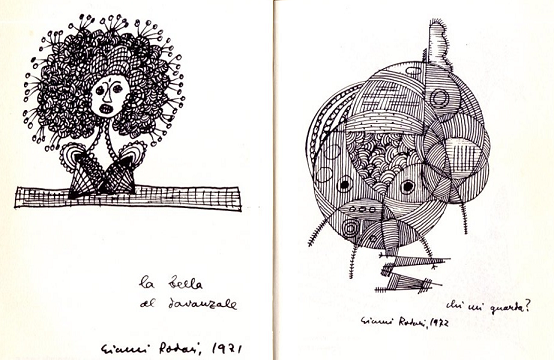
“La bella al davanzale” 1971 | “Chi mi guarda?” 1972 Gianni Rodari
The news of three wandering short stories has come to my attention… to be exact they are stories written by three outstanding Italian authors that have marked the history of Italian literature of the twentieth century.
At this point you must be wondering: “Who are these three?” OK, I’ll reveal them! They are Natalia Ginzburg, Gianni Rodari and Italo Svevo. Three authors that differ both for literary genre and for writing style.
Check out some goodies about them by doing this quiz:
How much do you know these three authors?
Time limit: 0
Quiz-summary
0 of 7 questions completed
Questions:
1
2
3
4
5
6
7
Information
Inizia il quiz!
You have already completed the quiz before. Hence you can not start it again.
Quiz is loading...
You must sign in or sign up to start the quiz.
You have to finish following quiz, to start this quiz:
Results
0 of 7 questions answered correctly
Your time:
Time has elapsed
You have reached 0 of 0 points, (0)
Average score
Your score
Categories
Not categorized0%
Congratulazioni!
1
2
3
4
5
6
7
Answered
Review
Question 1 of 7
1. Question
1 points
Which of these Italian authors is of Jewish origins?
Correct
Incorrect
Question 2 of 7
2. Question
1 points
Natalia Ginzburg was born in …
Correct
Incorrect
Question 3 of 7
3. Question
1 points
Gianni Rodari was one of the greatest writers of
Correct
Incorrect
Question 4 of 7
4. Question
1 points
Who was the English teacher of Italo Svevo?
Correct
Incorrect
Question 5 of 7
5. Question
1 points
Which of these books was not written by Italo Svevo?
Correct
Incorrect
Question 6 of 7
6. Question
1 points
Gianni Rodari said that with a bit of exercise you can take lessons in optimism from
Correct
Incorrect
Question 7 of 7
7. Question
1 points
He or she was anti-Fascist and in 1983 was elected in the lists of the Italian Communist Party to Parliament
Correct
Incorrect
“Will he go far? Will he be lucky? Straighten all the wrongs of this world? We do not know, because he is still marching with the courage and the determination of the first day. We can only wish him, with all our heart: – Have a good trip! ” (Gianni Rodari, The young shrimp, from “Fables on the phone”)
Ho buone notizie! Come ti avevo accennato poco tempo fa, mi diverte molto creare animazioni e ho quindi deciso di unire l’utile al dilettevole.
Allora ecco “Il Quizino” (la “z” ha un suono forte), una serie di animazioni di grammatica italiana che sicuramente non ti faranno sbadigliare mentre impari la lingua, ma al contrario, ti divertirai anche studiando cose complicate.
In questo primo video metterai alla prova le tue conoscenze verbali e precisamente il participio passato di tre verbi irregolari.
Dopo il quiz fai pratica creando delle frasi e non dimenticarti di condividerle nei commenti!
La prossima settimana arriverà il secondo video!
Buona visione e felice studio!
Mirella
I have good news! As Imentionedrecently,I really enjoycreatinganimations, soIdecided to combinebusiness with pleasure.
Here’s “Il Quizino”(the “z” hasastrong sound), a series ofanimated quizzesofItalian grammarthatdefinitelywill not make youyawnwhile you learnthe language, buton the contrary, you’ll have funalso studyingcomplicated things.
Inthis first video you will testyour verb skills andpreciselythe past participleof threeirregular verbs.
After the quiz practice making sentences and don’t forget to share them in the comments.