
google.com, pub-1205142185266664 , DIRECT, f08c47fec0942fa0

10 idee per studiare italiano in estate o in vacanza

Ci sono così tante alternative per praticare l’italiano in modo divertente. Cucinare, leggere, ascoltare musica. Puoi trovare ispirazione da ciò che ti piace. Ti presento 10 idee!

There are so many alternatives to practice Italian in a fun way. Cooking, reading, listening to music. You can just find inspiration from what you enjoy. These are 10 ideas!

1. Imparare vocabolario nuovo
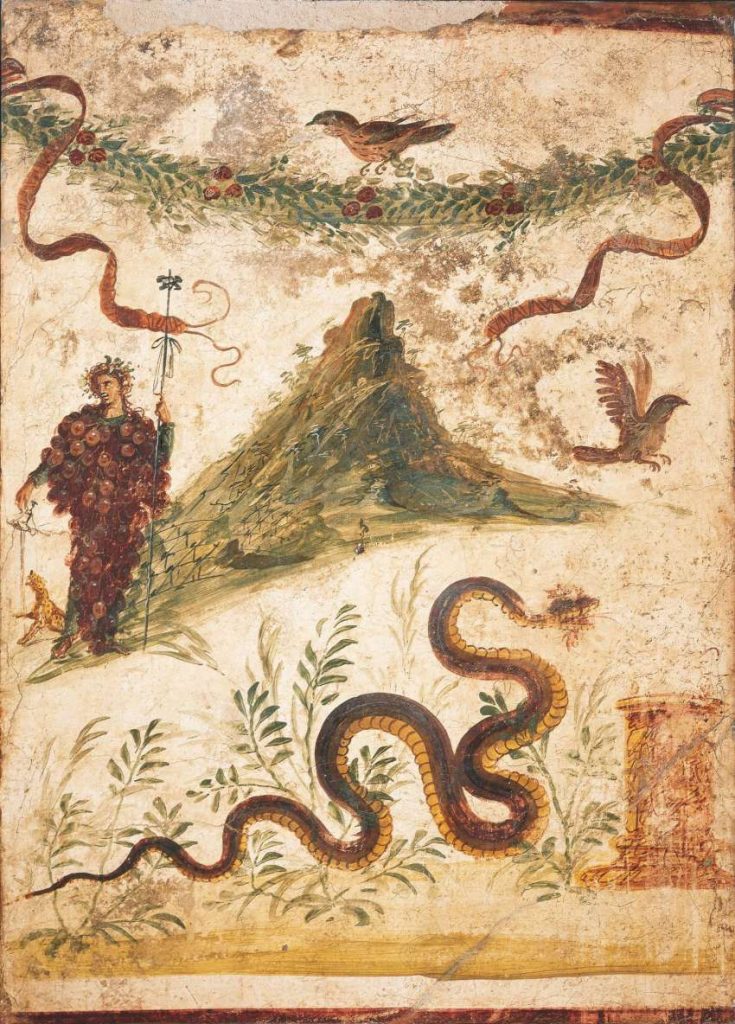
Secondo me imparare il vocabolario è più importante che sapere la grammatica. Le parole sono immediate nella comunicazione. Gli aggettivi in particolare sono quel gruppo di parole che ci aiutano a descrivere le cose. In questo caso conoscere la differenza tra “asciutto” e “secco” ci permette di dire se vogliamo per esempio la frutta secca o asciutta.

I think learning vocabulary is more important than learning grammar. Words are immediate in communication. Adjectives in particular are that group of words that help us describe things. In this case knowing the difference between “asciutto” and “secco” (dry) allows us to say if we want for example “frutta secca” or “frutta asciutta” .

2. Ascoltare podcast italiani
I migliori podcast italiani, lingua e dintorni

Si possono ascolare i podcast ovunque anche mentre si viaggia. Ormai esistono centinaia di podcast su qualsiasi argomento. La cosa bella è che l’esercizio di ascolto aiuta a migliorare la pronuncia e ad aumentare il vocabolario oltre a rendersi più informati.

You can listen to podcasts anywhere even while traveling. There are now hundreds of podcasts on any topic. The great thing is that listening exercises help improve pronunciation and increase vocabulary as well as make you more informed.

3. Leggere libri

Leggere: un’attività che aiuta non solo a godersi un po’ di meritato riposo, ma anche a migliorare la lingua e ad approfondire le conoscenze culturali dell’Italia.

Reading: an activity that helps not only to enjoy some well-deserved rest, but also to improve the language and deepen the cultural knowledge of Italy.

4. Cucinare ricette italiane
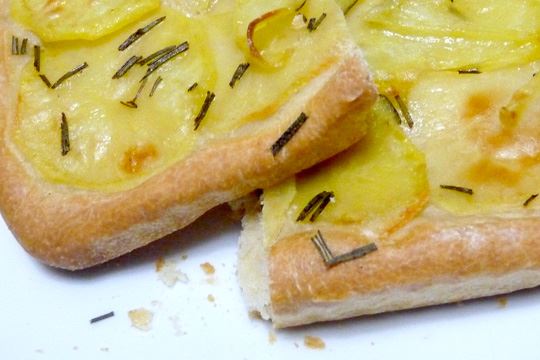
Pizza di patate

E ancora cibo!! Amo la pizza di patate. Conosci la canzone napoletana ‘A pizza’ di Giorgio Gaber? “Ma tu vuliv’a’pizza a’pizza a’pizza”… Pausa musicale: https://www.youtube.com/watch?v=eoIl5-2fYTo

And more food !! I love potato pizza. Do you know the Neapolitan song ‘A pizza’ by Giorgio Gaber:? “Ma tu vuliv’a’pizza a’pizza a’pizza … Music pause.

5. Studiare la storia italiana

Quando viaggiamo in Italia troviamo molte scritte romane, che a volte non capiamo. Neanch’io che ho studiato il latino a scuola! Sai che una tipologia di lettera in particolare è molto usata nel cinema.

When we travel in Italy we find many Roman writings, which we sometimes don’t understand. I don’t either even though I studied Latin at school! Did you know that a particular type of letter is widely used in cinema.

6. Fare esercizi divertenti di pronuncia
Uno degli esercizi più divertenti è fare pratica di pronuncia con degli scioglilingua quasi impossibili da dire velocemente!

One of the funnest exercises is practicing pronunciation with tongue twisters, almost impossible to say quickly!

7. Imparare aforismi italiani
Siamo beati dai tanti colori in estate. Il paesaggio ci offre tante opportunità e ispirazioni per esercitarci.

We are blessed with many colors in the summer. The landscape offers us so many opportunities and inspirations to practice.

8. Ascoltare musica
canzoni italiane allegre, happy Italian songs

Ancora musica, ma questa volta per praticare il congiuntivo. Forse il modo migliore per impararlo!

Still music, but this time to practice the subjunctive. Perhaps the best way to learn it!

9. Esplorare la cultura e la geografia
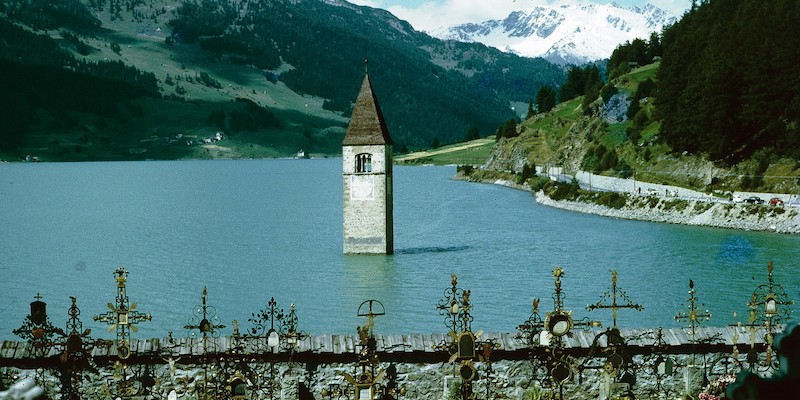
L’estate e le vacanze sono i periodi migliori per abbandonarci alle nostre esplorazioni della cultura.

Summer and holidays are the best times to indulge in our explorations of culture.

10. Imparare una cosa nuova di grammatica
E perché no…imparare o perfezare le nozioni di grammatica. In questo modo si fa una bella figura in viaggio per l’Italia!

And why not … learn or perfect the notions of grammar. This way you’ll make a great impression on your trip to Italy!
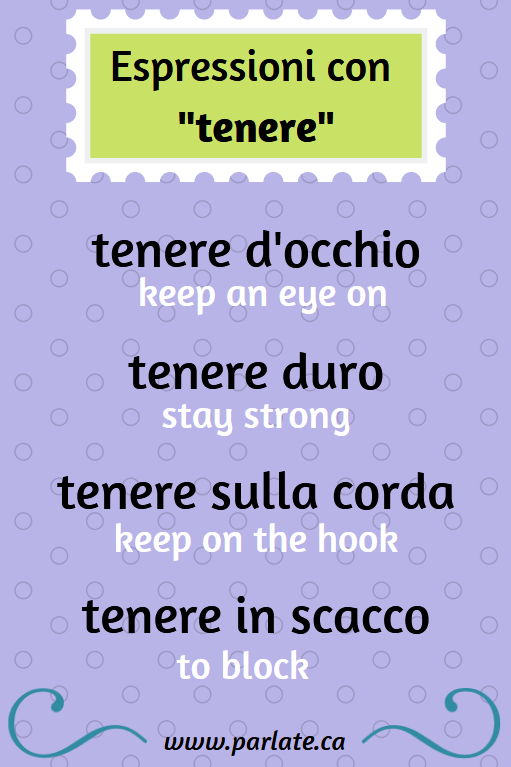
Espressioni con il verbo “tenere”

The verb “tenere” is one of those multi-purpose verbs just like the verb “get” in English. When it’s accompanied with different nouns or propositions, it takes on different meanings.

Il verbo “tenere” è uno di quei verbi multiuso proprio come il verbo “get” in inglese. Quando è accompagnato da nomi o preposizioni differenti, assume significati diversi.

The verb “tenere” is one of those multi-purpose verbs just like the verb “get” in English. When it’s accompanied with different nouns or prepositions, it takes on different meanings.

Ecco 19 degli usi più comuni con il verbo “tenere”. Non è facile impararli a memoria, ma ascoltandoli e ripetendoli molte volte diventeranno familiari.

Here are 19 of the most common uses of the verb “tenere”. It’s not easy to memorize them, but by listening to them and repeating them many times they’ll become familiar.

Tenere al buio – to keep someone in the dark:
Significa tenere qualcuno al buio di qualcosa, lasciarlo nell’ignoranza e non dargli notizia di qualcosa.

It means keeping someone in the dark of something, leaving them in ignorance and not giving them news of something.

Esempio:

Nelle dittature il popolo è tenuto al buio./ In dictaorships the population is kept in the dark.

Tenere banco – to lead the show:
Animare, rendere vivace una conversazione attirando su di sé l’attenzione di tutti.

Animate, make a conversation lively by attracting everyone’s attention.

Esempio:

Alle feste mio padre tiene sempre banco./ At parties my father always leads the show.

Tenere botta – to stay strong:
Vuol dire resistere, e non mollare nelle situazioni difficili ed anche dare valore ad un argomento.

It means resisting, and not giving up in difficult situations and also giving value to a topic.

Esempio:

La primavera tarda a venire, ma teniamo botta!/ The Spring is late, but we are staying strong!

Tenere dietro a qualcuno – to keep up with someone:
Significa seguire qualcuno e stare al suo passo. In senso figuritivo s’intende seguire, comprendere quanto dice una persona.

It means following someone and keeping up with them. In a figurative sense it means to follow, understand what a person is saying.

Esempio:

Non riuscivamo a tenerle dietro./ We weren’t able to keep up with her.

Tenere duro – to stay strong/to hold on:
Ha lo stesso significato di “tenere botta”, e cioè, perseverare.

It has the same meaning as “tenere botta”, that is, to persevere.

Esempio:

Terremo duro fino alla fine della corsa./ We’ll persevere until the end of the race.

Tenere la bocca cucita (o chiusa) – keep one’s mouth sealed:
Vuol dire tacere, fare silenzio o anche non divulgare informazioni su un argomento preciso.

It means being silent, quiet or even not disclosing information on a specific topic.

Esempio:

È un segreto quindi bisogna tenere la bocca cucita./ It’s a secret therefore we have to keep our mouths sealed.

Tenere la candela – to hold the candle:
Ci si riferisce a chi si trova ad essere solo insieme ad una coppia di innamorati o, comunque, di persone che si scambiano continue effusioni.

It refers to those who find themselves alone with a couple of lovers or, in any case, with people who are continuously exchanging effusions.

Esempio:

Non è divertente tenere la candela./ It’s not fun to hold the candle.

Tenere il becco chiuso – to keep one’s mouth shut:
Simile a “tenere la bocca chiusa”, ma può avere un tono meno cordiale e più perentorio, tipo “stare zitto”.

Similar to “tenere la bocca chiusa” , but it can have a less cordial and more peremptory tone, like “shut up”.

Esempio:

Spero che tu tenga il becco chiuso!/ I hope you keep your mouth shut!

Tenere il coltello dalla parte del manico – to have someone at the sharp end of the knife:
Essere in posizione vantaggiosa, e avere in pugno una situazione. Quindi essere in condizione d’imporre la propria volontà.

Being in an advantageous position, and having a situation under control. Therefore, being in a position to impose one’s will.

Esempio:

Alla fine della discussione teneva il coltello dalla parte del manico./ At the end of the argument he had us at the sharp end of the knife.

Tenere il piede in due scarpe (o due staffe) – to keep a foot in both camps:
Mantenere buoni rapporti con due parti in contrasto, per poi schierarsi con il più forte al momento opportuno. Fare il doppio gioco.

Maintaining good relationships with two contrasting parts, then taking sides with the stronger one at the right time. Playing a double game.

Esempio:

Gli opportunisti tengono il piede in due scarpe./ Opportunists keep a foot in both camps.

Tenere (o reggere) il sacco a qualcuno – hold the bag to someone:
Significa essere complice di qualcuno in un’azione di solito illecita.

It means being an accomplice of someone in a usually illicit action.

Esempio:

Preferisco non tenere il sacco a nessuno./ I prefer not to hold the bag to anyone.

Tenere in scacco – to keep in check:
Tenere qualcuno sotto minaccia in stato di inferiorità, quindi da bloccarlo.

Keeping someone under threat in a state of inferiority, by blocking them.

Esempio:

Se non fuggiamo, ci terrà in scacco. / If we don’t escape he’ll keep us in check.

Tenere sotto – to keàep under pressure to get something done:
Imporre una pressione mentale o fisica su un’altra persona in modo che dimostri la propria preparazione o che completi un lavoro.

Imposing a mental or physical pressure on another person so that they demonstrate their preparation or complete a job.

Esempio:

Gli investigatori lo hanno tenuto sotto per due ore./ The investigators kept him under pressure for two hours.

Tenere sott’occhio – to keep an eye on:
Non perdere di vista qualcuno o qualcosa e tenere in modo da potersi vedere agevolmente o da essere a portata della vista.

To not lose sight of someone or something and keep them so that you can see easily see them or is within sight.

Esempio:

Assicurati di tenere sott’occhio la valigia./ Make sure you keep an eye on the suitcase.

Tenere sotto una campana di vetro – to protect/wrap in cotton wool:
Significa custodire con molta cura.

It means guarding with great care.

Esempio:

Alcuni genitori tengono i figli sotto una campana di vetro./ Some parents wrap their children in cotton wool.

Tenere sulla corda – to hold on a rope:
Mantenere qualcuno in ansia, da lasciarli nel dubbio e nell’incertezza.

Keeping someone anxious, leaving them in doubt and uncertainty.

Esempio:

Chiamami quando arrivi, non tenermi sulla corda!/ Call me when you arrive, don’t hold me on a rope

Tenersi a galla – to stay afloat:
Guadagnare quello che basta per vivere o per far fronte agli impegni; anche, non lasciarsi travolgere dagli eventi.

Earning what you need to live or to meet commitments; also, not letting yourself be overwhelmed by events.

Esempio:

Hanno fatto di tutto per tenersi a galla./ They did everything to stay afloat.

Tenersi al largo – to steer clear of:
Riferito a navi e imbarcazioni che navigano a una certa distanza da terra. In senso figurativo, riferito alla condotta di un individuo, da cui tenersi al largo.

Referred to ships and boats sailing at a certain distance from the land. In a figurative sense, referring to the conduct of an individual, from whom to keep a distance.

Esempio:

Si tiene al largo dalle cattive amicizie./ She steers clear of bad friendships.

Tenersi le mani a cintola – to be unhelpful:
Si dice quando qualcuno non aiuta e non fa nulla. È inoperoso, specialmete quando altri lavorano

It’s said when someone doesn’t help and does nothing. They’re idle, especially when others work.

Esempio:

Mentre noi fatichiamo loro si tengono le mani a cintola./ While we work, they are unhelpful.

Expressions with the verb tenere / Espressioni con il verbo tenere

Conosci altre espressioni con il verbo “tenere”? Scrivele nei commenti.
Mi raccomando, tieni duro e ripeti molte volte queste 19 espressioni!

Do you know other expressions with the verb “tenere”? Write them in the comments.
Make sure, to stay strong and repeat these 19 expressions many times!


Mirella


How to use the double negative and ”mica” in Italian

La doppia negazione si usa quando non è seguito dal verbo + niente/ più/ mai
Esempi :

Non voglio più tornare in quel ristorante.
Non ho comprato niente in al negozio.
Non mangiamo più la pasta.
Non vengono mai a trovarvi?

The double negative is used when non is followed by the verb + niente/
più/ mai

Examples:

Non voglio più tornare in quel ristornate. / I don’t want to go back to that restaurant anymore.
Non ho comprato niente al negozio. / I didn’t buy anything at the store.
Non mangiamo più la pasta. /We don’t eat pasta anymore.
Non vengono mai a trovarvi? / Don’t they ever come to see you?

Se sono messi dopo il verbo, anche gli avverbi NEANCHE, NEMMENO, NEPPURE, hanno bisogno della negazione NON. Se invece sono posti prima del verbo la doppia negazione non si usa.
Esempi:

Nemmeno Maria è venuta al cinema = Non è venuta al cinema nemmeno Maria.
Neppure ieri ho lavorato = Non ho lavorato neppure ieri.
Neppure i nostri amici sono stati in Italia = Non sono stati in Italia neppure i nostri amici
Neanche lei verrà con noi = Non verrà con noi neanche lei.
Neanche la libreria vendeva quel libro = La libreria non vendeva neanche quel libro.

If they are placed after the verb, the adverbs NEANCHE, NEMMENO, NEPPURE, also require NOT. If instead they are placed before the verb the double negation is not used.
Examples:

Nemmeno Maria è venuta al cinema = Non è venuta al cinema nemmeno Maria. / Not even Maria came to the cinema.
Neppure ieri ho lavorato = Non ho lavorato neppure ieri. / I didn’t work yesterday either.
Neppure i nostri amici sono stati in Italia = Non sono stati in Italia neppure i nostri amici. / Not even our friends have been to Italy.
Neanche lei verrà con noi = Non verrà con noi neanche lei. / Not even she will come with us.
Neanche la libreria vendeva quel libro = La libreria non vendeva neanche quel libro. / Not even the bookstore sold that book.

Nell’italiano parlato l’avverbio di negazione “non” può essere sostituito o rafforzato dall’avverbio MICA, nel significato di “per nulla, affatto”. Usato in funzione rafforzativa, “mica” va sempre dopo il verbo.
Esempi:
Questo è riso biologico, mica di bassa qualità.
Non ho mica letto il tuo messaggio!

In spoken Italian the adverb of negation “not/non” can be replaced or strengthened by the adverb MICA, meaning “not at all/not even”. Used as a strengthening function, “mica” is always placed after the verb. In English it may sound redundant.
Examples:

Questo è riso biologico, mica di bassa qualità.  /This is organic rice, not at all of low quality.
Non ho mica letto il tuo messaggio!  I have not at all read your message!

Per esercitarti, prova a fare delle frasi nei commenti e fai il quiz. / To practice try making some sentences in the comments and do the quiz.

How to use the double negative and mica

Inizia il quiz!

Alla prossima!
Mirella


How to use the verb dovere


In a recent article I explained how to use “potere”
 
Let’s rejoice that among the 4 verbi modali, potere, volere, dovere, sapere, also known as verbi servili, potere is the most difficult to grasp.
 
So, take a sigh of relief, un sospiro di sollievo, because it will only get easier now. Trust me, fidati!
 
In this article we’ll tackle the verb dovere
 
As I mentioned previously, the hardest part when using i verbi modali is knowing when to use l’imperfetto and il passato prossimo. 
 
However, when you use dovere keep these rules in mind to simplify the translation with regards to these two tenses.
 
L’imperfetto:
  • the obligation to do something
  • the necessity to do something
  • supposed to do something, but didn’t do it
Dovevo finire i compiti prima di uscire.
– I had to finish my homework before going out.
 
Dovevo imparare l’imperfetto prima di fare gli esercizi.
– I needed to learn the imperfect before doing the exercises.
 
Dovevo chiamarti, ma ho perso il tuo numero.
– I was supposed to call you, but I lost your number.
 
 
Il passato prossimo :
  • the obligation to do something – usually in a specific time in the recent past
  • the necessity to do something – usually in a specific time in the recent past
Oggi ho dovuto finire i compiti prima di uscire.
Today I’ve had to finish my homework before going out.
 
Ho dovuto imparare l’imperfetto durante il semestre.
– I’ve needed to learn the imperfect during the semester.
 
Tutto chiaro? Try the quiz below and let me know in the comments how it goes.
 
If you know someone who struggles with i verbi modali,  share this with them!
 
Alla prossima, 
Mirella
 

Quiz: how to use dovere

Inizia il quiz!


Read about another ”verbo modale” :

How to use the verb potere

La Storia della Cultura Italiana: Gli Etruschi

 
Join ITALIANO ALLA MANO for weekly study plans, downloadable learning material and more:

How to use time schedules in Italian

Come leggere le date e le ore in italiano

Do you know how to use time schedules in Italian…or book a table at a restaurant, read opening and closing information at la pasticceria or il museo, etc.?

Also, did you know that “ferie” from the Latin word “feria” meaning holiday / party, while “feriale” means work day (from Monday to Friday)?

“Today’s use of the feminine plural noun “ferie” maintains the original meaning of ‘festive period, mostly summer rest’ .The weekday adjective (from the Latin ferialis) follows, semantically, the ecclesiastical calendar and indicates the days of the week not holidays (not dedicated to the celebration of the solemnity of Jesus or of Our Lady), therefore working days. In French, however, the ancient meaning has remained in the formula “jours fériés”, ‘holidays’.” via Accademia della Crusca

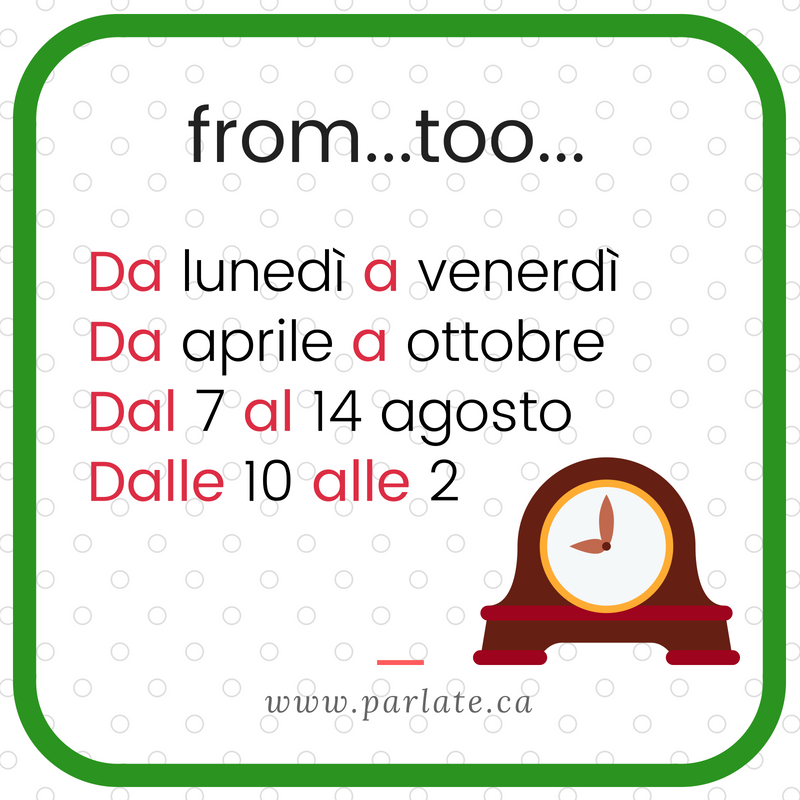
These situations all require the use of the prepositions ”da” and ”a” in the following cases:

Day

from Monday to Friday – Da lunedì a venerdì

Month

from April to October – da aprile a ottobre

Date

from  the 7th to the 14 of August – dal 7 al 14 agosto

Time

from 10AM to 2PM – dalle 10 alle 14

Vocabolario:

giorno festivo – holiday

giorno feriale – weekday

chiuso – closed

aperto – open

giorno di chiusura – closed on…

orario – time schedule

orario estivo – summer schedule

orario invernale – winter schedule

pomeriggio chiuso – closed in the afternoon/lunchbreak

orario continuato – open in the afternoon/lunchbreak


Related image

Practice making appointments in the comments. Are there any other situations where you need to make an appointment in Italy?

Let me know in the comments!


How do you compare things in Italian?

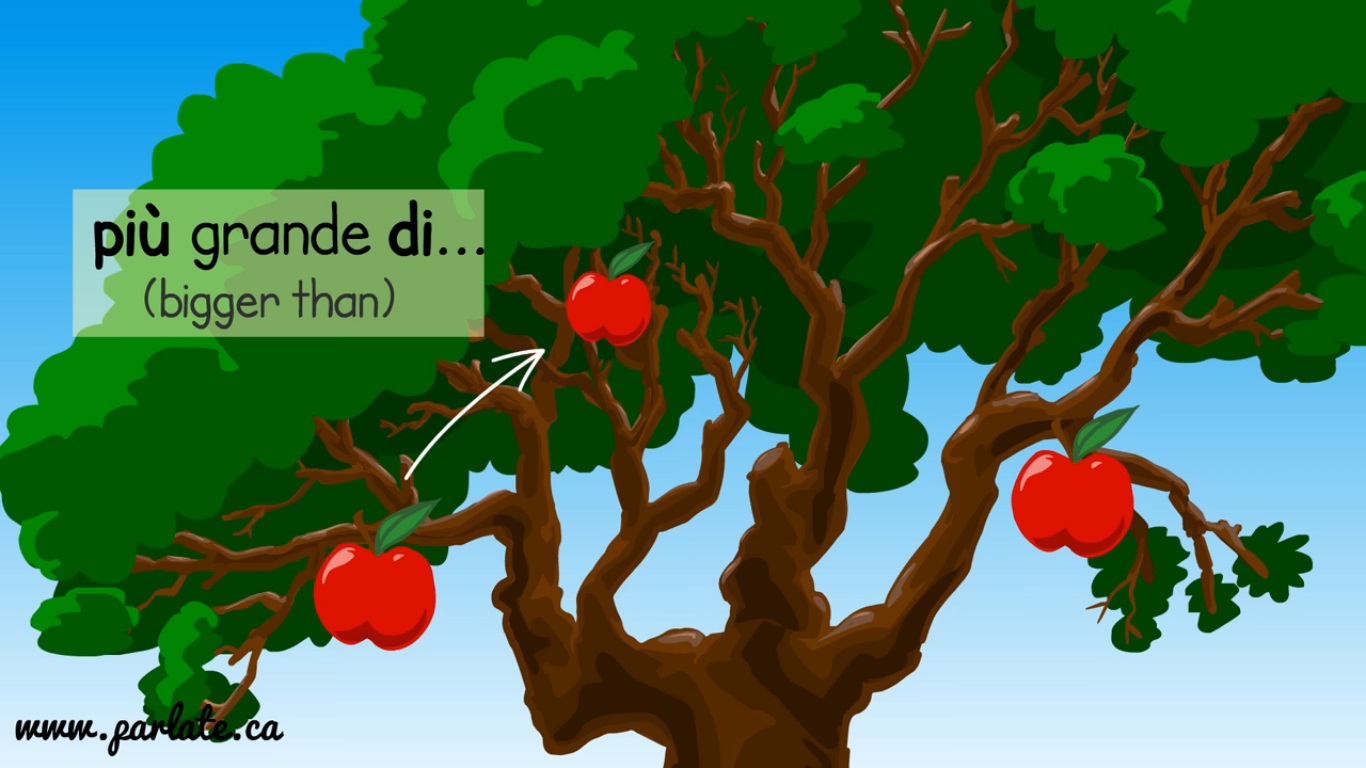
I 3 comparativi in italiano

Being able to compare things (comparare, fare paragoni) is essential especially if you are among  Italians: “This coffee is stronger than that one” … “That train is slower than the other” …

In these videos I explain how to use the comparative in Italian in 3 different cases. 


Special Comparatives and Superlatives

adjective

comparative

relative comparative

absolute superlative

buono – good

cattivo (brutto) – bad

grande – big

small – piccolo

alto – high

basso – low

migliore – better

peggiore – worse

maggiore – bigger

minore – smaller

superiore – higher

inferiore – lower

il migliore – the best

il peggiore – the worst

il maggiore – the biggest

il minore – the smallest

il superiore – the highest

l’inferiore – the lowest

ottimo – excellent

pessimo – terrible

massimo – maximum

minimo – minimum

supremo – supreme

infimo – worthless

Examples:

1) He is the worst politician in the Italian history.
– Lui è il peggiore candidato nella storia italiana.

2) This wine is terrible.
– Questo vino è pessimo.

3) In the winter Canadian weather is worse than Italian weather.
In inverno il clima canadese è peggiore di quello italiano.

Let me know in the comments which comparativo è più bello!

A presto,
Mirella


How to use the verbs piacere and mancare in Italian

Come si usano i verbi piacere e mancare?


English follows

Allora, come si usa il verbo piacere? E’ una domanda che ricevo spesso. Credo che sia una buona idea rivedere come usare il verbo “piacere”, e verbi simili come “mancare” “servire”, “interessare”, ecc.

Per esempio, in italiano “mancare” può essere usato in diversi modi con vari significati. Vedremo il caso in cui significa “desiderare” indicando impazienza per qualcosa.

In questo caso segue una costruzione particolare che è comune anche ad altri verbi come “piacere” (vedi l’elenco sotto): ciò che ci piace è il soggetto mentre la persona che esprime apprezzamento diventa un pronome indiretto.

Mi (pronome indiretto) manca (verbo) l’Italia (soggetto).
Mi manca l’Italia.

È importante prendersi un momento per ripassare i pronomi  indiretti e ricordare dove sono inseriti in una frase. Vedi la scheda in basso. Esistono 2 forme di pronomi indiretti: forma atona e forma tonica. La forma tonica è solitamente usata per enfatizzare.

SINGULAR forma atonaSINGULAR forma tonica
before the verbbefore/after the verb
mi (to/for) mea me (to/for) me
ti (to/for) youa te (to/for) you
gli (to/for) hima lui (to/for) him
Le/le (to/for) you (formal m. and f.)a Lei/a lei (to/for) you (formal m. and f.)
PLURAL forma atonaPLURAL forma tonica
before the verbbefore/after the verb
ci (to/for) usa noi (to/for) us
vi (to/for) youa voi (to/for) you
gli (to/for) thema loro (to/for) them

Ricorda:

– Il verbo essere è l’ausiliare al passato prossimo: “Mi sono mancati i miei amici”. oppure “I miei amici sono mancati a me”.
– Il verbo mancare è singolare se seguito da un infinito: “Mi manca mangiare gli spaghetti”.
– A seconda della forma di pronome indiretto che stai utilizzando, la posizione dell’oggetto e del soggetto può essere invertita: “Mi manca l’Italia” o “L’Italia manca a me”.

piacere – to like, to be pleasing
bastare – to be sufficient
attrarre – to attract
occorrere – to need
succedere – to happen
restare – to remain
servire – to serve
interessare – to interest
disgustare – to disgust
parere – to appear
sembrare – to seem
volerci – to take

📝 ESERCIZIO: COME USARE MANCARE (clicca qui) 📝

You cannot copy content of this page