google.com, pub-1205142185266664 , DIRECT, f08c47fec0942fa0

25 verbi riflessivi con l’imperfetto

25 reflexive Italian verbs with the imperfect

(English follows)

In questa lezione ci eserciteremo con 25 verbi riflessivi comuni all’imperfetto, un tempo semplice che quindi non utilizza un ausliare.

A differenza del passato prossimo, un tempo composto (clicca qui per ri-esercitarti!) che si coniuga sempre con l’ausiliare usare ESSERE.

Latini dicevano che, “repetita iuvant”, ripetere le cose giova. Infatti a scuola i professori ce lo ripetevano spesso. Per studiare bene e imparare bene bisogna sempre ripetere e non avere fretta di avanzare al prossimo argomento. Nel caso dello studio delle lingue, ripetere a voce alta ti aiuta a parlare bene.


In this lesson, we’ll practice 25 common reflexive verbs in the imperfect, a simple tense that doesn’t use an auxiliary verb.

Unlike the passato prossimo, a compound tense (click here to practice again!), it’s always conjugated with the auxiliary verb ESSERE.

The Latins used to say that “repetita iuvant”—repeating things is beneficial. In fact, teachers often told us this in school. To study and learn well, you need to constantly repeat and not rush to move on to the next topic. When studying languages, repeating things out loud helps you speak well.


Scarica il PDF della lezione / Download the PDF of the lesson:

28 frasi con piacere, servire, mancare + imperfetto

28 sentences with piacere, servire, mancare + imperfetto

(English follows)

Questo video serve a molti studenti d’italiano che studiano i verbi e in particolare i verbi piacere, servire e mancare che sono accompagnati dai pronomi indiretti.
Se vi mancavano degli esercizi su questi verbi allora penso che questo vi piacerà! Fatemi sapere se ne volete altri.

Ricordiamo che l’imperfetto si usa per ->
– esprimere azioni abituali o ripetute nel passato,
– descrivere persone, luoghi o situazioni nel passato,
– indicare azioni continuate o in svolgimento nel passato, spesso come sfondo a un’azione puntuale espressa da un altro tempo verbale.

Come si forma l’imperfetto ->
si prende il tema del presente del verbo e si aggiunge una vocale tematica (-a-, -e-, -i-) e le desinenze tipiche:
-vo, -vi, -va, -vamo, -vate, -vano

Ad esempio:

“guardare” (1ª coniugazione) = “io guardavo”;  

“mettere” (2ª coniugazione) =  “io mettevo”; 

“sentire” (3ª coniugazione) =  “io sentivo”

Ricordiamo che con i verbi piacere, servire, mancare->si usano i pronomi indiretti:
a me/mi, a te/ti, a lei/le, a lui/gli, a noi/ci, a voi/vi, a loro/gli


Scarica il PDF della lezione / Download the PDF of the lesson:


This video is needed by many Italian students studying verbs, particularly the verbs piacere, servizio, and mancare, which are accompanied by indirect pronouns.
If you were missing exercises on these verbs, then I think you’ll like this one!
Let me know if you’d like more.

Let’s remember that l’imperfetto is used for ->
– expressing habitual or repeated actions in the past,
– describing people, places, or situations in the past,
– indicating continuos or ongoing actions in the past, often as a backdrop to a specific action expressed by another verb tense.

How to form l’imperfetto ->
the present stem of the verb is taken and a thematic vowel is added
(-a-, -e-, -i-) and the typical endings:
-vo, -vi, -va, -vamo, -vate, -vano

For example:

“guardare” (1ª coniugazione) = “io guardavo”;  

“mettere” (2ª coniugazione) =  “io mettevo”; 

“sentire” (3ª coniugazione) =  “io sentivo”

Let’s remember that with the verbs piacere, servire, mancare-> you use indirect pronouns:
a me/mi, a te/ti, a lei/le, a lui/gli, a noi/ci, a voi/vi, a loro/gli


Come studiare l’italiano in estate o in vacanza?

How to study Italian in the summer or on vacation?

Se stai per fare una vacanza estiva, ho una buona notizia, puoi continuare a praticare l’itaiano. Anzi, puoi portare l’italiano con te: a passeggio o in bici tra i sentieri ascoltando un podcast oppure seduti all’ombra di un albero o di un ombrellone leggendo un libro. Non hai che l’imbarazzo della scelta per rilassarti e immergerti nella bella lingua. Ecco alcuni suggerimenti!

If you are going on summer vacation, I have good news, you can continue practicing Italian. In fact, you can take Italian with you: walking or biking along the paths listening to a podcast or sitting in the shade of a tree or a beach umbrella reading a book. You are spoiled for choice to relax and immerse yourself in the beautiful language. Here are some suggestions.

1. Impara vocabolario nuovo

Imparare il vocabolario (verbi, sostantivi, aggettivi, congiunzioni, avverbi, ecc.) è essenziale per parlare una lingua ed è più importante che sapere la grammatica. Un buon vocabolario ci aiuta a comunicare quello che vogliamo usando le parole giuste.

Learning vocabulary (verbs, nouns, adjectives, conjunctions, adverbs, etc.) is essential to speaking a language and it is more important than knowing grammar. A good vocabulary helps us communicate what we want using the right words.

2. Ascolta un podcast italiano

Sono un’assidua ascoltatrice del Podcast “Denominazione di origine inventata” che parla dell’origine della cucina italiana. Ad ogni puntata scopro cose nuove!
L’esercizio di ascolto ci aiuta a migliorare la pronuncia e ad ampliare il vocabolario. Inoltre, asoltare dei podcast di cultura italiana ci rende più informati e colti. Ormai esistono centinaia di podcast su qualsiasi argomento, storia, arte, viaggio, cucina e cosi via.

I am a regular listener of the Podcast “Denominazione di origine inventata” which talks about the origin of Italian cuisine. I discover new things with each episode!
Listening exercises help us improve our pronunciation and expand our vocabulary. Furthermore, listening to podcasts about Italian culture makes us more informed and knowledgable. There are now hundreds of podcasts on any topic, history, art, travel, cuisine and so on.

3. Leggi racconti italiani

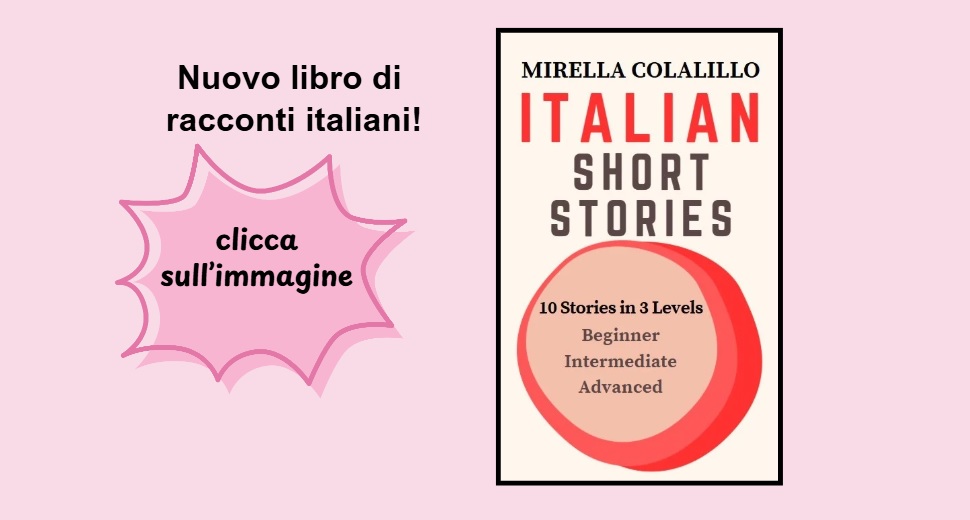
Se ti piace leggere racconti, questo libro fa per te. Ogni racconto è stato scritto in 3 livelli. Quindi se sei un principiante puoi leggere le storie nel livello A1 per principianti, ma avanzando con l’italiano potrai poi leggere il livello B1 e poi quello C1! Ogni racconto usa le stutture grammaticali e il vocabolario per quel livello. Se invece il tuo livello è C1, troverai interessante anche paragonare e analizzare la lingue nei tre livelli.

If you like reading short stories, this book is for you. Each story has been written in 3 levels. So if you are a beginner you can read the stories in the A1 level for beginners, but as you advance with your Italian you can then read the B1 level and then the C1 level! Each story uses the grammatical structures and vocabulary for that level. If your level is C1, you will also find it interesting to compare and analyze the languages ​​in the three levels.

4. Impara l’italiano con storie guidate

Questi video-racconti ti guidano nella lettura, pronuncia e comprensione. Ti incoraggiano a parlare attraverso la ripetizione a due diverse velocita. Le domande di comprensione ti aiutano a ricordare e riformulare il vocabolario e le frasi della storia. Ogni storia ha un PDF scaricabile gratis e ogni mese pubblico almeno due video, quindi resta all’ascolto per i prossimi!

These video stories guide you through reading, pronunciation, and comprehension. They encourage you to speak through repetition at two different speeds. Comprehension questions help you remember and reformulate the vocabulary and sentences in the story. Each story has a free downloadable PDF, and I publish at least two videos each month, so stay tuned for the next ones!

5. Studia la storia italiana

Uno dei miei articoli culturali preferiti sul mio blog che parla dell’evoluzione delle lettere dall’Antica Roma. Quando viaggiamo in Italia troviamo molte scritte romane, che a volte non capiamo. Mi aiuta aver studiato il latino a scuola. Sai che una tipologia di lettera in particolare è molto usata nel cinema.

One of my favorite cultural articles on my blog about the evolution of letters from Ancient Rome. When we travel in Italy we find a lot of Roman writing, which sometimes we don’t understand. It helps that I studied Latin in school. You know that one type of letter in particular is used a lot in cinema.

6. Impara barzellette italiane

E’ non solo un libro di barzellette, ma un libro di barzellette per parlare l’italiano. Il libro ha 52 barzellette da imparare, una per ogni settimana dell’anno, e ti incoraggia ad imparare a raccontare le barzellette in italiano. Per ogni barzelletta trovi anche uno spunto grammaticale. Parlare e ridere, cosa c’è di meglio!

It’s not just a joke book, but a joke book to speak Italian. The book has 52 jokes to learn, one for each week of the year, and encourages you to learn how to tell jokes in italian. For each joke you also find a grammatical tip. Talking and laughing, what’s better!

7. Ascolta e canta canzoni italiane

La lingua è musica! Ascoltare canzoni e, ancora meglio, cantarle è non solo divertente, ma è il miglior esercizio per migliorare la pronuncia poiché le parole diventano parte della melodia senza alcuno sforzo. Inoltre, la canzone è un esercizio di ripetizione e, come sappiamo, più ripetiamo, più ricordiamo e più impariamo!

Language is music! Listening to songs and, even better, singing them is not only fun, but it is the best exercise to improve pronunciation because the words become part of the melody without any effort. Furthermore, the song is an exercise in repetition and, as we know, the more we repeat, the more we remember and the more we learn!

8. Studia un argomento di grammatica

E perché no…imparare o perfezionare le nozioni di grammatica. In questo modo si fa una bella figura in viaggio per l’Italia!

And why not … learn or perfect your notions of grammar. This way you’ll make a great impression on your trip to Italy!


32 frasi ipotetiche del primo tipo in italiano

32 first-type hypothetical sentences in Italian


(English follows)

Quante volte durante la giornata iniziamo una frase con la parolina “se” per esprimere una ipotesi, una possibiltà, una realtà, una impossibiltà? Tante!

Per esempio:

“Se mangi troppi dolci, ti viene il mal di stomaco.”

Questa è una frase ipotetica del primo tipo della realtà che si costruisce con il presente indicativo + il presente indicativo ed esprime una ipotesi presentata come un fatto reale o plausibile.

In tutto ci sono 5 modi per formare una frase ipotetica del primo tipo della realtà.

Qualche esempio:

1. se + indicativo presente + indicativo presentese non mangi, hai fame;

2. se + indicativo presente + indicativo futuro se partiamo tardi, perderemo il treno;

3. se + indicativo futuro + indicativo futuro se verrai, ceneremo insieme.

4. se + indicativo passato + indicativo futurose hai portato il libro, lo leggerò.

5. se + indicativo presente + imperativo se avete sete, bevete!

Ci sono tre tipi di frasi ipotetiche oltre a quelle miste, ma ricordare quali verbi usare in ciascun caso rischia di diventare un gioco mnemonico poco pratico. La strategia migliore è di ricordare il suono attraverso la ripetizione orale.

Nel video potrai ascotare e ripetere 32 frasi ipotetiche del primo tipo.
Più le ripeti, più diventerà naturale formularle senza pensarci, in quanto svilupperai una memoria orale. Ti consiglio di ripeterle spesso e di esercitarti a scriverne altre nei commenti.


Scarica il PDF della lezione / Download the PDF of the lesson:

English version

How many times during the day do we start a sentence with the little word “if” to express a hypothesis, a possibility, a reality, an impossibility? Many!

For example:

“Se mangi troppi dolci, ti viene il mal di stomaco.”
(“If you eat to many sweets, you’ll get a stomach ache)

This is a hypothetical sentence of the first type of reality constructed with the present indicative + the present indicative and expresses a hypothesis presented as a real or plausible fact.

In total there are 5 ways to form a hypothetical sentence of the first type of reality.

Some examples:

1. se + indicativo presente + indicativo presentese non mangi, hai fame;

2. se + indicativo presente + indicativo futuro se partiamo tardi, perderemo il treno;

3. se + indicativo futuro + indicativo futuro se verrai, ceneremo insieme.

4. se + indicativo passato + indicativo futurose hai portato il libro, lo leggerò.

5. se + indicativo presente + imperativo se avete sete, bevete!

There are three types of hypothetical sentences in addition to mixed ones. Since remembering which verbs to use in each case risks becoming an impractical mnemonic game, the best strategy is to remember the sound with oral repetition.
In the video you will be able to listen to and repeat 32 first-type hypothetical sentences.
The more you repeat them, the more natural it will become to formulate them without thinking, as you will develop an oral memory. I recommend that you repeat them often and practice writing some in the comments.

Esercizio di pronuncia italiana: 20 scioglilingua

20 ITALIAN TONGUE TWISTERS / SCIOGLILINGUA | Ascolta e Ripeti

Gli scioglilingua: aiutano a migliorare la dizione e a parlare fluentemente.
/
Tongue Twisters: help improve diction and speak fluently.

Ascolta e ripeti ciascun scioglilingua alle 2 velocità. Ripeti questo esercizio un paio di volte ogni settimana.
/
Listen and repeat each tongue twister at the 2 speeds. Repeat this exercise a couple of times every week.

20 Scioglilingua – 20 Tongue twisters:

Scarica il PDF del video / Download the PDF of the video:


32 frasi ipotetiche del secondo tipo in italiano

32 second-type hypothetical sentences in Italian

(English follows)

Alcuni pensano che il congiuntivo abbia i giorni contati. Tuttavia, lo studio del congiuntivo e del condizionale aiuta a formulare in italiano delle frasi e dei concetti i più complessi.
Per esempio:
“Se studiassi il congiuntivo imperfetto, farei delle frasi ipotetiche del secondo tipo.”
Questa è una frase ipotetica del secondo tipo che si costruisce con il congiuntivo imperfetto e con il condizionale presente. Ci sono tre tipi di frasi ipotetiche oltre a quelle miste. Siccome ricordare quali verbi usare in ciascun caso rischia di diventare un gioco mnemonico poco pratico, la strategia migliore è di ricordarne il suono e la modulazione con la ripetizione orale.
Nel video potrai ascotare e ripetere 32 frasi ipotetiche del secondo tipo.
Più le ripeti, più diventerà naturale formularle senza pensarci, in quanto svilupperai una memoria orale. Ti consiglio di ripeterle spesso e di esercitarti a scriverne altre nei commenti.


Scarica il PDF della lezione / Download the PDF of the lesson:


Some people think that the subjunctive has its days numbered. However, studying the subjunctive and the conditional helps to formulate more complex sentences and concepts in Italian.
For example:
“Se studiassi il congiuntivo imperfetto, farei delle frasi ipotetiche del secondo tipo.”
(“If I studied the imperfect subjunctive, I would make second-type hypothetical sentences.”)
This is a second-type hypothetical sentence that is constructed with the imperfect subjunctive and the present conditional. There are three types of hypothetical sentences in addition to mixed ones. Since remembering which verbs to use in each case risks becoming an impractical mnemonic game, the best strategy is to remember the sound and modulation with oral repetition.
In the video you will be able to listen to and repeat 32 second-type hypothetical sentences.
The more you repeat them, the more natural it will become to formulate them without thinking, as you will develop an oral memory. I recommend that you repeat them often and practice writing some in the comments.

25 verbi riflessivi in italiano

25 reflexive verbs in Italian

25 verbi riflessivi comuni al passato prossimo per non dimenticare quale ausiliare usare….sempre lo stesso: ESSERE!
Latini dicevano che, “repetita iuvant”, ripetere le cose giova, fa bene. Infatti a scuola i professori ce lo ripetevano spesso. Quando si studia non bisogna fermarsi a capire e poi passare subito al prossimo argomento. Per quanto riguarda lo studio delle lingue, ripetere giova soprattutto oralmente.

25 reflexive verbs in passato prossimo to not forget which auxiliary ti use…always the same one: ESSERE! The Latins used to say that, “repetita iuvant”, repeating things is
beneficial, it does good. In fact, at school, teachers often repeated it
to us. When studying, you should not stop to understand
and then immediately move on to the next topic. As far as studying
languages ​​is concerned, repetition is especially beneficial orally.


Scarica il PDF della lezione / Download the PDF of the lesson:

You cannot copy content of this page