Studiando l’italiano hai mai incontrato dei verbi seguiti da una preposizione e poi da un altro verbo all’inifinito o al gerundio? Sono dei verbi fraseologici e a volte ti fanno grattare il capo se non sai come usarli! Vediamo in particolare come si usano i verbi fraseologici venire a prendere e andare a prendere.
I verbi venire a prendere e andare a prendere sono chiamati verbi fraseologici. Sono usati davanti a un altro verbo all’infinito o al gerundio e sono spesso accompagnati da una preposizione.
I verbi fraseologici esprimono una particolare azione, per esempio: cominciare a +infinito – (inizio dell’azione) finire di + infinito – (fine dell’azione) continuare a +infinito – (proseguimento dell’azione) stare per + gerundio – (progressività dell’azione)
I verbi venire a + prendere e andarea + prendere indicano il movimento di un’azione.
Vediamo alcune frasi:
Venire a prendere – to come get, pick up
1. Vengo a prendere la mia bici domani quando sarà pronta.
2. Stasera i miei amici vengono a prendere dell’uva del mio orto.
3. Sono venuti a prenderci alla fermata dell’autobus.
4. Ti veniamo a prendere all’aeroporto.
Andare a prendere– to go get, pick up
1. Siete andati a prendere un caffè al bar?
2. Ogni giorno va a prendere la figlia all’uscita dalla scuola.
3. Sono andati a prendere le chiavi dell’appartamento.
4. Domani andremo a prendere del vino in cantina.
Consiglio
Quando hai dei dubbi, per non sbagliare, consulta sempre il dizionario!
Continua a esercitarti nell’Accademia dei Verbi. Troverai tanti esercizi efficaci che ti aiuteranno a coniugare tutti i tempi verbali e a pronunciarli bene:
English version
While studying Italian, have you ever encountered verbs followed by a preposition and then by another verb in the infinitive or gerund? They are phrasal verbs and sometimes they make you scratch your head if you don’t know how to use them! Let’s see in particular how to use the phrasal verbs venire a prendere and andare a prendere.
The verbs venire a prendere and andare a prendere are called phrasal verbs. They are used before another verb in the infinitive or gerund and are often accompanied by a preposition.
Phrasal verbs express a particular action, for example: cominciare a +infinito – (start of an action) finire di + infinito – (end of an action) continuare a +infinito – (continuation of an action) stare per + gerundio – (progression an action)
The verbs venire a + prendere e andarea + prendere indicate the movement of an action.
Let’s have a look at some sentences:
Venire a prendere – to come get, pick up
1. Vengo a prendere la mia bici domani quando sarà pronta. I’ll come get my bike tomorrow when it’s ready.
2. Stasera i miei amici vengono a prendere dell’uva del mio orto. Tonight my friends are coming to get some grapes from my garden.
3. Sono venuti a prenderci alla fermata dell’autobus. They came to pick us up at the bus stop.
4. Ti veniamo a prendere all’aeroporto. We will pick you up at the airport.
Andare a prendere– to go get, pick up
1. Siete andati a prendere un caffe al bar? Have you gone to and get a coffee at the bar?
2. Ogni giorno va a prendere la figlia all’uscita dalla scuola . Every day he goes to pick up his daughter from school.
3. Sono andati a prendere le chiavi dell’appartamento. They went to get the keys to the apartment.
4. Domani andremo a prendere del vino in cantina. Tomorrow we will go to the cellar to get some wine.
Suggestion:
When in doubt, to avoid making mistakes, always consult the dictionary!
Continua a esercitarti (continue to practice) in the Accademia dei Verbi. You will find many effective exercises that will help you conjugate all the verb tenses and pronounce them well:
Come usare le forme pronominali confidenziali e di cortesia
(English follows)
La domanda che ti sarai chiesto è: “Quale forma pronominale italiana devo usare per rivolgermi ad una persona….confidenziale/informale o di cortesia /formale?”
Allora vediamo come si usano i diversi pronomi allocutivi: tu, voi, Lei, Ella, Loro.
Pronomi allocutivi Un pronome allocutivo è una forma pronomiale che viene utilizzata per rivolgersi a una persona in modo diretto, come ad esempio “tu”, “lei”, “voi”, “vostra eccellenza”, “signor(e)”, “amico(a)”, “cara/o”, ecc. Un pronome allocutivo viene utilizzato per indicare la persona con cui si sta parlando in modo più diretto e personale, generalmente con l’intento di stabilire un rapporto di familiarità o rispetto.
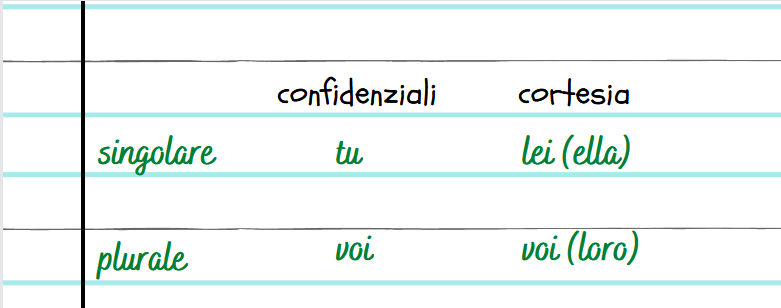
L’italiano contemporaneo prevede due forme di uso dei pronomi allocutivi nei rapporti interpersonali:
– confidenziali il tu reciproco, riservato in genere ai rapporti informali (amicizie, famiglia, lavoro, con colleghi che si frequentano abitualmente);
– di cortesia(o di rispetto o reverenziali) il “Lei”reciproco, nei rapporti formali (ambito di lavoro e istituzionale fra persone che non si conoscono, rapporti gerarchici). L’uso del “voi” come alternativa al “Lei” nelle situazioni formali è quasi del tutto scomparso e sopravvive in alcuni italiani regionali meridionali.
Nella storia della lingua italiana, il pronome formale ha subito diverse trasformazioni. Fino al Trecento si usavano solo il “tu” e il “voi” come forme di rispetto, sia al singolare che al plurale. In seguito, è stato sostituito dal pronome “Vostra Signoria” in modo formale al singolare e “Vostra Maestà” al plurale per rivolgersi ai nobili e alla famiglia reale. Dal Quattrocento al Seicento si è diffuso gradualmente l’uso del “Lei” probabilmente per l’influsso dello spagnolo usted. Fino ai primi del Novecento“Lei “/ “ella” e “voi” erano usati indistintamente. Nel 1938 il regime fascista ha proibito ufficialmente l’uso del “Lei” a favore del “voi”. È forse proprio questa imposizione ha sancito l’abbandono del voi nel secondo dopoguerra. “Lei” ha di conseguenza acquisito un ruolo più centrale nel linguaggio formale come pronome di cortesia per indicare una persona singola.
Negli ultimi decenni il “tu” ha gradualmente ampliato la sua sfera d’uso, estendendosi a situazioni in cui prima non era previsto. Di fronte a una diversa sensibilità dei parlanti, è consigliabile non abusare del tu in situazioni formali e mantenere il lei, specie con persone che non si conoscono.
Esempi con “Lei”:
1. Mi scusi, Signora, potrebbe ripetere quello che ha detto?
2. La ringrazio per la sua gentilezza e disponibilità.
3. Signore, qui troverà tutte le informazioni di cui ha bisogno.
4. Lei è il nostro cliente più fedele.
Attenzione:
Quando si usa il pronome allocutivo “Lei”, il participio passato del predicato si accorda con il genere della persona alla quale si riferisce
Caro Professore, a lezione ieri (Lei) è stato davvero brillante.
Se però l’allocutivo è in forma di pronome atono, il participio può accordarsi al femminile anche se ci si riferisce a un maschio
Caro Professore, l’ho (la ho) sentita parlare alla conferenza di ieri.
“Loro” può essere usato come pronome di cortesia quando ci si rivolge a persone che non si conoscono molto bene o in situazioni formali. Tuttavia, in Italiano, è più comune utilizzare il pronome “Lei” come forma di cortesia singolare, mentre “Loro” è utilizzato come forma di cortesia plurale.
“Ella” è limitato agli usi burocratici o altamente formali (in questo secondo caso, in riferimento ad alte cariche religiose o civili) e di solito si accompagna all’uso delle maiuscole di reverenza. Anche loro è marcato ormai come molto formale, e viene usato sempre più di rado: per rivolgersi collettivamente a persone alle quali singolarmente si darebbe del lei, oggi si ricorre quasi sempre al “voi“.
Pronomi neutri
Attualmente, in italiano, l’uso dei pronomi di terza persona (lui/lei) è ampiamente diffuso e non prevede l’uso di pronomi neutri per riferirsi a persone non binarie. Tuttavia, sempre più persone usano pronomi alternativi come “loro” o “elle” o “ellx” per riferirsi a sé stessi o ad altre persone non binarie ed includere tutte le identità di genere. Anche se l’uso di questi pronomi non è ancora ampiamente diffuso, è importante rispettare la preferenza di ogni individuo sulla forma di pronome che preferisce usare per sé.
Inoltre, alcuni linguisti e studiosi del linguaggio stanno lavorando per recuperare il genere neutro nella lingua italiana, proponendo nuove forme linguistiche o recuperando forme già esistenti ma poco utilizzate. Tuttavia, questi tentativi non hanno ancora ottenuto un ampio consenso e l’uso del genere neutro nell’italiano attuale è ancora in fase sperimentale.
Ricapitoliamo:
Tu, Maria, sei tanto gentile.
Voi siete bravissime, ragazze!
Signor Neri, Lei ha una padronanza eccellente della lingua italiana.
Ella Ella ha la nostra stima, signor Presidente
Loro sono pregati di entrare.
English version
The question you may have asked yourself is: “Which Italian pronominal form should I use to address a person….formal or informal?”
So let’s see how the different allocutive pronouns are used: tu, voi, Lei, Ella, Loro.
Allocutionary pronouns An allocution pronoun is a pronomial form that is used to address a person directly, such as “tu”/you, “Lei”/you, “voi”/you, “Vostra Eccellenza”/your Excellency, “signor(e)”/Sir, “amico(a)”/friend, “cara/o”/dear, etc. An allocution pronoun is used to indicate the person with whom you are speaking in a more direct and personal way, generally with the intention of establishing a relationship of familiarity or respect.
Contemporary Italian foresees two forms of allocutive pronouns in interpersonal relationships:
– confidential reciprocal “tu”/you, generally reserved for informal relationships (friendships, family, work, with colleagues who meet regularly);
– courtesy (or respect or reverential) the mutual “Lei”, in formal relationships (work and institutional environment between people who don’t know each other, hierarchical relationships). The use of “voi” as an alternative to “Lei” in formal situations is almost entirely disappeared and survives in some southern Italian regions.
In the history of the Italian language, the formal pronoun has undergone several transformations. Until the fourteenth century, only “tu”/you and “voi”/you were used as forms of respect, both in the singular and in the plural. Later, it was replaced by the pronoun “Vostra Signoria”/ “Your lordship” formally in the singular and “Vostra Maestà”/”Your Majesty” in the plural to address nobles and the royal family. From the fifteenth to the seventeenth century the use of “Lei” gradually spread, probably due to the influence of the Spanish “usted”. Until the early twentieth century “Lei “/ “ella” /you, and “voi”/you were used interchangeably. In 1938 the fascist regime officially forbade the use of “Lei” in favor of “Voi”. Perhaps it was precisely this imposition that sanctioned the abandonment of “voi” after the Second World War.”Lei” has consequently acquired a more central role in formal language as a courtesy pronoun for a single person.
In recent decades, “tu” has gradually expanded its sphere of use, extending itself to situations in which it was not previously foreseen. Faced with a different sensibility of the speakers, it is advisable not to abuse “tu” in formal situations and to keep the “Lei”, especially with people who don’t know each other.
Examples with “Lei”:
1. Mi scusi, Signora, potrebbe ripetere quello che ha detto? – Excuse me, Madam, could you repeat what you said?
2. La ringrazio per la sua gentilezza e disponibilità. – Thank you for your kindness and availability.
3. Signore, qui troverà tutte le informazioni di cui ha bisogno. – Sir, here you will find all the information you need.
4. Lei è il nostro cliente più fedele. – You are our most loyal customer.
Attention: When the allocutive pronoun “Lei” is used, the past participle of the predicate agrees with the gender of the person to whom it refers:
Caro Professore, a lezione ieri (Lei) è stato davvero brillante. –Dear Professor, in class yesterday (you) were really brilliant.
However, if the allocutive is in the form of an unstressed pronoun, the participle can agree in the feminine even if it refers to a male:
Caro Professore, l’ho (la ho) sentita parlare alla conferenza di ieri. – Dear Professor, I heard you speak at yesterday’s conference.
“Loro” can be used as a polite pronoun when addressing people who don’t know each other very well or in formal situations. However, in Italian, it is more common to use the pronoun “Lei” as a singular courtesy form, while “Loro” is used as a plural courtesy form.
Examples with “Loro”:
Loro sono invitati a prendere posto al tavolo. – You are invited to take a seat at the table.
Loro gradirebbero una bevanda? – Would you like a drink?
Potrebbero gentilmente fornirci maggiori dettagli sull’argomento? – Could you kindly give us more details on the matter?
Loro hanno fatto un ottimo lavoro. – You’ve done a great job.
“Ella” is limited to bureaucratic or highly formal uses (in the latter case, in reference to high religious or civil offices) and is usually accompanied by the use of capital letters of reverence. Even “Loro” is now marked as very formal, and is used more and more rarely: to collectively address people to whom one would address individually with “you”, today we almost always resort to “voi”.
Neutral pronouns Currently, in Italian, the use of third person pronouns (he/she) is widespread and does not include the use of neuter pronouns to refer to non-binary people. However, more and more people are using alternative pronouns such as “loro/they” or “elle” or “ellx” to refer to themselves or other non-binary people and include all gender identities. While the use of these pronouns is not yet widely used, it is important to respect each individual’s preference on the form of pronoun she prefers to use for herself. Furthermore, some linguists and language scholars are working to recover the neuter gender in the Italian language, proposing new linguistic forms or recovering existing but little-used forms. However, these attempts have not yet achieved widespread acceptance and the use of the neuter gender in present-day Italian is still in an experimental stage.
Let’s recap:
Tu, Maria, sei tanto gentile. – You, Maria, are so kind.
Voi siete bravissime, ragazze! – You are great, girls!
Signor Neri, Lei ha una padronanza eccellente della lingua italiana. – Mr. Neri, you have an excellent command of the Italian language.
Ella ha la nostra stima, signor Presidente. – You have our respect, Mr. President
Loro sono pregati di entrare. – You are requested to enter.
4 canzoni per raccontare facili storie in italiano, seconda parte
Hai cantato le canzoni della Prima Parte ? Erano corte e con semplici ripetizioni. La melodia e la ripetizione aiutano a migliorare la pronuncia.
In questa seconda parte ascoltiamo e cantiamo quattro canzoni che raccontano storie. Essere in grado di raccontare storie semplici è un bel traguardo che tutti vogliono raggiungere. La musica è il mezzo migliore per allenarsi.
Le quattro canzoni di popolari cantanti italiane fanno parte di un’epoca passata in cui la musica aveva una poesia diversa.
Did you sing the songs of the first part? They were short and with simple repetitions. Melody and repetition help improve pronunciation. In this second part we listen to and sing four songs that tell stories. Being able to tell simple stories is a great achievement that everyone wants to reach. Music is the best way to practice. The four songs by popular Italian singers are part of a bygone era where music had a different poetry.
vola colomba- Nilla pizzi (1952)
Brano originale del 1952 Brano cantato da Nilla Pizzi con l’orchestra di Ennio Morricone. La colomba era il messaggio che l’Italia uscita sconfitta e umiliata dalla guerra, inviava a Trieste, contesa fra i comunisti jugoslavi di Tito, gli inglesi e gli americani che la stavano occupando con le armi. La guerra a Trieste non finì infatti nel 1945 come nel resto del Paese, ma nel 1954 quando le truppe italiane ritornarono a liberarla.
Original piece from 1952 sung by Nilla Pizzi with the orchestra of Ennio Morricone. The dove “la colomba” was the message that Italy, defeated and humiliated by the war, sent to Trieste, disputed between Tito’s Yugoslav Communists, the British, and the Americans who were occupying it with arms. In fact, the war in Trieste did not end in 1945 as in the rest of the country, but in 1954 when the Italian troops returned to free it.
Pinguino Innamorato – Silvana Fioresi e Trio Lescano (1941)
Mentre la dittatura si avviava verso una terribile guerra e ancor più terribile guerra civile, il pubblico si deliziava con delle canzonette accattivanti per la melodia e lo swing. In contrasto le parole potrebbero essere definite come surreali, bizzarre, e grottesche.
As the dictatorship moved towards a terrible war and even more terrible civil war, the audience delighted with captivating songs for melody and swing. In contrast, the words could be defined as surreal, bizarre, and grotesque.
Canzone Da Due Soldi – Katyna Ranieri (1957)
Una canzone da due soldi, ci invita a vedere la vera felicità nel poco. Questi versi danno una voce “poetica” al dopoguerra, scuotono le masse ed entrano nelle case di un popolo assetato di normalità.
A simple song “una canzone da due soldi”, invites us to see true happiness in little. These verses give a “poetic” voice to the postwar period, it shakes the masses and enters the homes of a people thirsty for normality.
Casetta in Canadà – Carla Boni (1957)
Una canzone con un ritmo allegro ed accattivante con un testo – genere nonsense – di facile memorizzazione che si può ripetere all’infinito. Un grande successo fra gli Italiani emigrati in Canada.
A song with a cheerful and captivating rhythm with a text – nonsense genre – easy to memorize that can be repeated indefinitely. A great success among Italians who emigrated to Canada.
Mi raccomando canta ogni giorno, fa bene non solo allo studio dell’italiano ma anche alla salute!
I recommend singing every day, it’s good not only for your Italian, but also for your health!
A simple rule to use them correctly.
Una regola semplice per usarli correttamente.
English follows
Diciamocelo…i verbi italiani non sono proprio una passeggiata. Può infatti capitare di avere dei dubbi nel scegliere il tempo giusto al momento giusto. I due tempi verbali che capita a moltissimi di confondere sono l’imperfetto e il passato prossimo. Comunque ho un trucco facile facile per capire quando usare l’uno o l’altro. Sono sicura che applicarlo ti faciliterà la vita.
Ecco come funziona:
se parli di un’azione abituale nel passato, usi l’imperfetto. In inglese equivale a “used to”.
se parli di un’azione passata conclusa, avvenuta una o più volte, usi il passato prossimo.
Facciamo degli esempi:
imperfetto 1. L’anno scorso andavo in montagna. – Last year I used to go to the mountains.
passato prossimo 2. L’anno scorso sono andato in montagna. – Last year I went to the mountains.
ESERCIZIO – Scegli il tempo giusto:
Anni fa i maschi avevano/hanno avuto un unico problema esistenziale al mare: scegliere a quale categoria di uomo in costume da bagno appartenere. Slip o boxer? Il peso dell’apparenza estiva cadeva/è caduto sulle donne. L’uomo invece era/è stato funzionale alla vacanza: caricava/ha caricato l’auto di valigie, biciclette e gommoni, guidava/ha guidato fino a destinazione, montava/ha montato e smontava/ha smontato tavolini e ombrelloni, apriva/ha aperto e chiudeva/ha chiuso sdraio, gonfiava/ha gonfiato e sgonfiava/ha sgonfiato canotti. Provava/ha provato a cimentarsi in qualche attività sportiva che non praticava/ha praticato mai durante l’anno, combatteva/ha combattuto con il vento contrario alla direzione del suo riporto, fingeva/ha finto di approfondire le pagine di politica e sport. (adattato da Donna Moderna)
TRADUZIONE: Years ago, males used to have a single existential problem at the sea: choosing which category of man in a bathing suit to belong to. Slip or boxer? The weight of summer appearance used to fall on the women. The man, on the other hand, used to be functional to the holiday: he used to load the car with suitcases, bicycles and rafts, he sued to drive to their destination, he used to assemble and disassemble tables and umbrellas, he used to open and close deck chairs, he used to inflate and deflate dinghies. He used to try his hand at some sporting activity that he never used to practice during the year, he used to fight the wind against the direction of his come over, he used to pretend to deepen the pages of politics and sport. (adapted from Donna Moderna)
Soluzione in basso!
ENGLISH VERSION
Let’s face it … Italian verbs are not exactly a walk in the park. In fact, it may happen to have doubts in choosing the right tense at the right time. The two tenses that many people get confused are the imperfetto and the passato prossimo. However, I have a very easy trick for figuring out when to use one or the other. I’m sure applying it will make your life easier.
Here’s how it works:
if you talk about a habitual action in the past, you use the imperfetto. In English it is equivalent to “used to”.
if you are talking about a completed past action, that occurred once or more times, you use the passato prossimo.
Let’s make some examples:
imperfetto 1. L’anno scorso andavo in montagna. – Last year I used to go to the mountains.
passato prossimo 2. L’anno scorso sono andato in montagna. – Last year I went to the mountains.
EXERCISE – Choose the correct tense:
Anni fa i maschi avevano/hanno avuto un unico problema esistenziale al mare: scegliere a quale categoria di uomo in costume da bagno appartenere. Slip o boxer? Il peso dell’apparenza estiva cadeva/è caduto sulle donne. L’uomo invece era/è stato funzionale alla vacanza: caricava/ha caricato l’auto di valigie, biciclette e gommoni, guidava/ha guidato fino a destinazione, montava/ha montato e smontava/ha smontato tavolini e ombrelloni, apriva/ha aperto e chiudeva/ha chiuso sdraio, gonfiava/ha gonfiato e sgonfiava/ha sgonfiato canotti. Provava/ha provato a cimentarsi in qualche attività sportiva che non praticava/ha praticato mai durante l’anno, combatteva/ha combattuto con il vento contrario alla direzione del suo riporto, fingeva/ha finto di approfondire le pagine di politica e sport.(adattato da Donna Moderna)
TRANSLATION: Years ago, males used to have a single existential problem at the seaside: choosing which category of man in a bathing suit to belong to. Slip or boxer? The weight of summer appearance used to fall on the women. The man, on the other hand, used to be functional to the holiday: he used to load the car with suitcases, bicycles and rafts, he sued to drive to their destination, he used to assemble and disassemble tables and umbrellas, he used to open and close deck chairs, he used to inflate and deflate dinghies. He used to try his hand at some sporting activity that he never used to practice during the year, he used to fight the wind against the direction of his comb-over, he used to pretend to deepen the pages of politics and sport. (adapted from Donna Moderna)
SOLUZIONE: Anni fa i maschi avevano un unico problema esistenziale al mare: scegliere a quale categoria di uomo in costume da bagno appartenere. Slip o boxer? Il peso dell’apparenza estiva cadeva sulle donne. L’uomo invece era funzionale alla vacanza: caricava l’auto di valigie, biciclette e gommoni, guidava fino a destinazione, montava e smontava tavolini e ombrelloni, apriva e chiudeva sdraio, gonfiava e sgonfiava canotti. Provava a cimentarsi in qualche attività sportiva che non praticava mai durante l’anno, combatteva con il vento contrario alla direzione del suo riporto, fingeva di approfondire le pagine di politica e sport.(adattato da Donna Moderna)
4 Facili canzoni italiane per migliorare l’italiano
Quando la vita diventa caotica, c’è la musica a sostenermi. Canto sempre, soprattutto quando la vita diventa pesante. Sai che cantare in italiano è uno dei modi migliori per migliorare la lingua? La ripetizione di parole accompagnata da una melodia non solo migliora la pronuncia, ma migliora anche la fiducia nel parlare fluentemente. Ho scelto 4 semplici canzoni italiane per cominciare.
When life becomes chaotic there is music to support me. I always sing, especially when life gets heavy. Do you know that singing in Italian is one of the best ways to improve the language? Repetition of words accompanied by a melody not only improves pronunciation but also improves one’s confidence in speaking fluently. I’ve chosen 4 simple Italian songs to start with.
Ancora tu – Lucio Battisti
Canzone perfetta per fare domande e frasi negative.
Perfect songs for asking questions and making negative sentences.
Non credere – Mina
Una buona canzone per esercitarsi con l’imperativo.
A good song to practice the imperative.
Il mondo – Jimmy Fontana
Una canzone per praticare il presente con stile.
A song to practice the present with style.
Pensiero Stupendo – Patty Pravo
Una canzone stupenda e semplice con un tocco di condizionale.
A beautiful and simple song with a touch of conditional.
Mi raccomando canta ogni giorno, fa bene non solo allo studio dell’italiano ma anche alla salute!
I recommend singing every day, it’s good not only for your Italian, but also for your health
Oggi parliamo di interiezioni, di cui l’italiano è ricco. Credo che potrebbero bastare per fare discorsi interi… eh, ahimè, be’ , povero me…mah!
L’interiezione si usa per esprimere emozioni, stati d’animo e reazioni istintive condensate in una sola espressione, senza legami sintattici con il resto della frase.
Molte interiezioni hanno origine vernacolare e vengono utilizzate con frequenza maggiore o minore a seconda della provenienza geografica dell’interlocutore, ma ormai quasi tutte sono entrate a diritto nell’uso della lingua italiana.
Comunque per essere compresa bisogna conoscerne il contesto. Per questo motivo l’interiezione si può definire deittica, cioè legata a un qui e ora ben determinato.
In base all’intonazione, l’interiezione è in grado di assumere il significato di un’intera frase.
Come le espressioni del viso le interiezioni esprimono un messaggio chiaro all’interlocutore senza il bisogno di aggiungere altro.
Invece quando ci troviamo di fronte a un testo scritto è necessario integrare l’interiezione con qualche parola che ne specifichi il senso, siccome non possiamo basarci sul tono con cui viene pronunciata.
Le interiezioni sono divise in due differenti gruppi:
Interiezioni che generalmente contengono la lettera h, sono brevi e assumono unicamente valore interiettivo come oh, ahimè, ahi…
Interiezioni che prendono a prestito parti del discorso anche molto diverse tra loro (avverbi, aggettivi, sostantivi, intere proposizioni…) e le utilizzano con valore esclamativo o interrogativo (bene!, evviva!, attenzione!).
Poi all’interno del secondo gruppo si trovano interiezioni improprie e locuzioni interiettive formate da proposizioni e modi di dire (povero me!, santa pazienza!).
All’interno della prima categoria: è facile individuare interiezioni semplici, composte e onomatopeiche:
Semplici – si compongono di uno o due suoni vocalici e possono esprimere dolore (ahi!, ohi!), esitazione o impaccio (ehm, uhm), repulsione (ih!), dubbio (mah, boh), sorpresa (uh!) e molti altri sentimenti e impulsi.
Composte – sono formate generalmente da un’interiezione semplice in combinazione con un pronome personale oppure da due parole (ahimè, orsù, suvvia…). Anche queste voci possiedono diverse sfumature di significato in base al contesto.
Onomatopeiche – come dice il nome stesso, derivano da suoni riconoscibili e provengono per la maggior parte dal mondo del fumetto (puah, splash, clap, toc, wow…).
Sicuramente tutte le interiezioni hanno un valore onomatopeico perché si basano sull’intonazione e il suono, e quindi più che prestare attenzione alle denominazioni dovremmo avere ben chiare le distinzioni e la provenienza etimologica di queste piccole istintive parti del discorso.
È importante poi la giusta grafia delle interiezioni! Spesso troviamo errori molto gravi come ho! al posto di oh!. L’h va messa sempre alla fine (eh, beh, mah, toh…) tranne nel caso in cui ci siano due vocali come per esempio in ehi!, ahi! e i loro composti come ahinoi! e nel caso di ehm euhm, dove si posiziona in mezzo.
Infine è possibile trovare O senza h quando si tratta di un vocativo (O cari fratelli!, O amica mia!). L’imperativo alla seconda persona singolare troncata di alcuni verbi funge talvolta da interiezione come nel caso di te’ per “tieni”, va’ per “guarda (ant. varda)”. Oppure ancora dall’apocope di alcune parole come be’ per “bene”.
Today we’re talking about interjections, of which Italian is rich. I think they might be enough to make whole speeches … eh, ahimè, be’ , povero me…mah!
The interjection is used to express emotions, moods and instinctive reactions condensed into a single expression, without syntactic links with the rest of the sentence.
Many interjections have a vernacular origin and are used with greater or lesser frequency depending on the geographical origin of the interlocutor, but now almost all of them have rightfully entered the use of the Italian language.
However, in order to be understood, it is necessary to know the context. For this reason, the interjection can be defined as deictic, that is, linked to a well-determined here and now.
Based on the intonation, the interjection is able to take on the meaning of an entire sentence. Like facial expressions, the interjections express a clear message to the interlocutor without the need to add anything else.
Instead, when we are faced with a written text it is necessary to integrate the interjection with some words that specify its meaning, since we cannot rely on the tone in which it is pronounced.
The interjections are divided into two different groups:
Interjections that generally contain the letter h, are short and assume only interjective value such as oh, ahimè, ahi…
Interjections that borrow parts of speech that are also very different from each other (adverbs, adjectives, nouns, whole sentences…) and use them with exclamation or interrogative value (bene!, evviva!, attenzione!). Then within the second group there are improper interjections and interjective phrases formed by propositions and idioms (povero me!, santa pazienza!).
Within the first category: it is easy to identify simple, compound and onomatopoeic interjections:
Simple – consist of one or two vowel sounds and can express pain (ahi!, ohi!) , hesitation or embarrassment (ehm, uhm) , repulsion (ih!), doubt (mah, boh), surprise (uh!) and many other feelings and impulses.
Compounds – are generally formed by a simple interjection in combination with a personal pronoun or by two words (ahimè, orsù, suvvia…) . These interjections also have different shades of meaning depending on the context.
Onomatopoeic – as the name implies, they derive from recognizable sounds and come for the most part from the world of comics (puah, splash, clap, toc, wow…).
Surely all the interjections have an onomatopoeic value because they are based on intonation and sound, and therefore, rather than paying attention to the denominations, we should be very clear about the distinctions and the etymological origin of these small instinctive parts of the speech.
The correct spelling of the interjections is also important! We often find very serious mistakes like ho! instead of oh!. . The h must always be placed at the end (eh, beh, mah, toh…) except in the case in which there are two vowels such as in ehi!, ahi! and their compounds like ahinoi and in the case of ehm and uhm, where it sits in the middle.
Finally, it is possible to find O without h when it’s a vocative (O cari fratelli!, O amica mia!) . The imperative in the truncated second person singular of some verbs sometimes acts as an interjection as in the case of te’ for “here/take” , va’ for “guarda (ant. varda)” . Or again from the apocope of some words such as be’ for “bene” .
L’anno di Dante 2021. Quiz su Dante e la Divina Commedia
Continuiamo il nostro viaggio dantesco. La settimana scorsa ho scritto di Dante e dell’anno di Dante 2021 che trovi al seguente link: Celebriamo il sommo poeta- 2021 l’anno di Dante Ti sarà molto utile prima di fare il quiz di oggi. Il quiz è in italiano, ma se hai delle difficoltà e hai bisogno di aiuto nella comprensione di qualche domanda fammelo sapere nei commenti e non dimenticare di scrivere anche il tuo punteggio. Clicca su “view questions” alla fine per vedere le risposte. In bocca al lupo!