Written by Janine C. Funk / Scritto da Janine C. Funk
Article edited by Mirella. For simplicity we used passato prossimo instead of passato remoto
The History of Italian Culture / La Storia della Cultura Italiana
Part 1: The Etruscans / Capitolo I: Gli Etruschi
When you think of Italy, you probably think of Rome, the ancient heart of the Classical world and the center of one of history’s most esteemed empires. With 7.3 million international visitors in 2017, the city remains a top tourist destination and cultural landmark. But before the Colosseum and the Forum, before the Pantheon and the Arch of Constantine, when Rome was just a small collection of pastoral settlements whose names have been long lost to history, Italy belonged to the Etruscans.
Quando pensi all’Italia, pensi probabilmente a Roma, il cuore antico del mondo Classico ed il centro di uno degli imperi più stimati della storia. Con 7,3 milioni di turisti internazionali nel 2017, la città rimane una destinazione superlativa e una pietra miliare della cultura. Però, prima del Colosseo e del Foro, prima del Pantheon e del Arco di Constantino, quando Roma era solo un piccolo gruppo di cittadine pastorali i cui nomi si perdono nella storia, l’Italia ha appartenuto agli Etruschi.
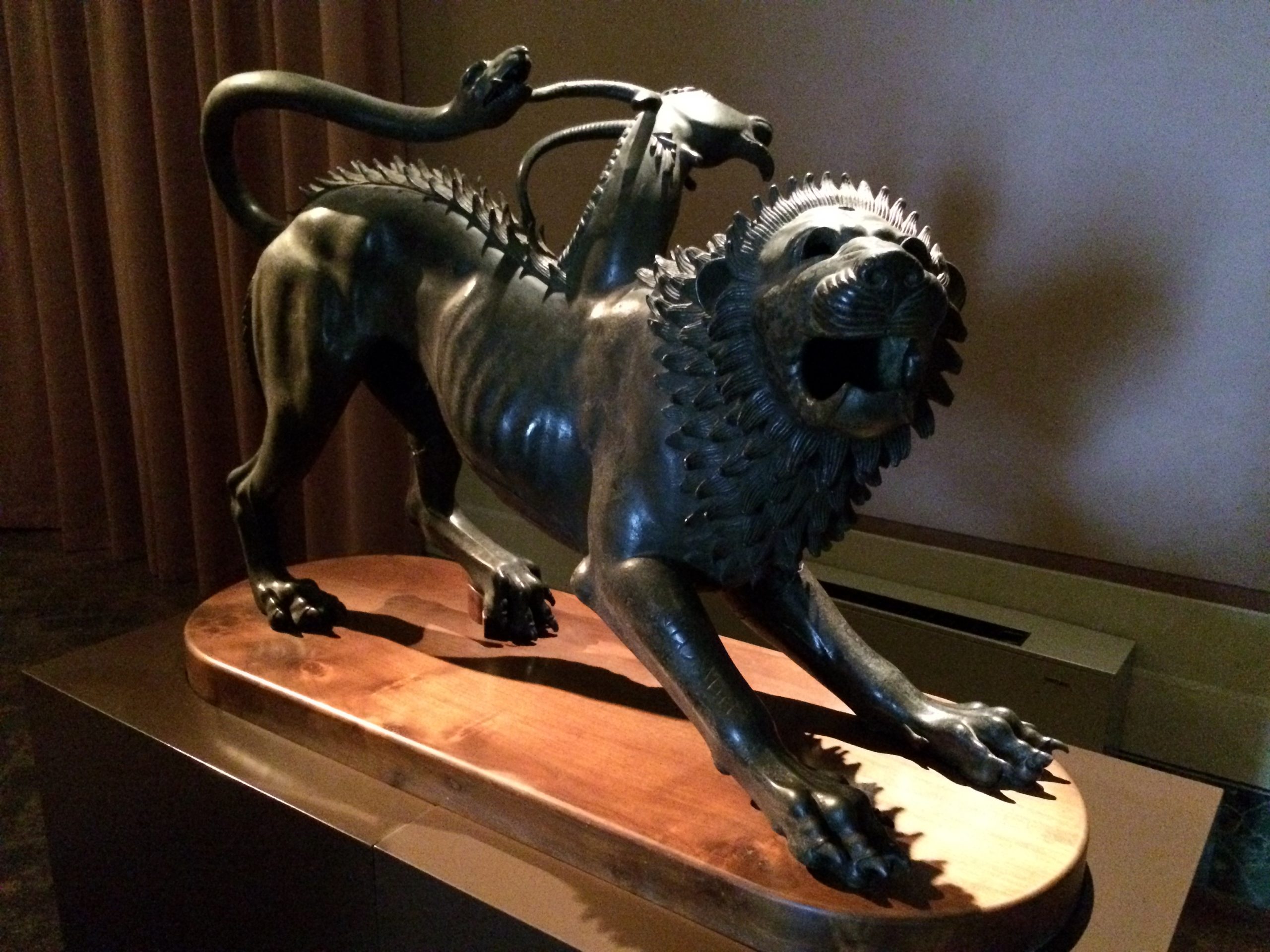
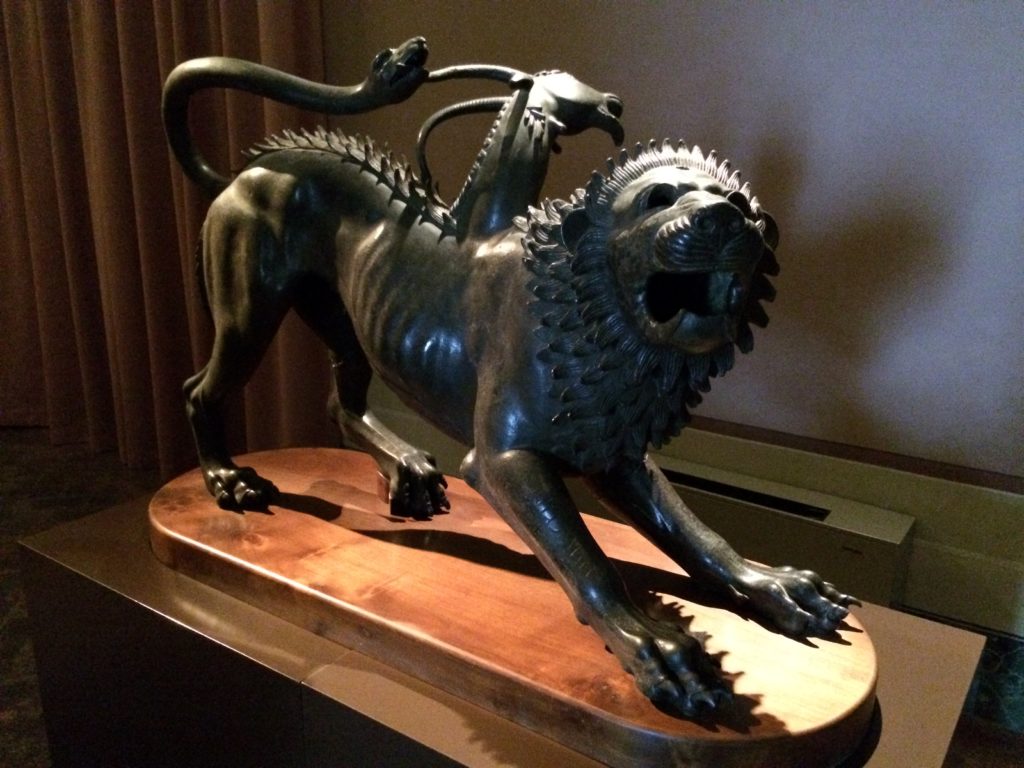
la Chimera d’Arezzo, ca. 375-350 a.C., Firenze, Museo dell’Archaeologia
The Etruscans were a group of indigenous peoples that inhabited the area of central Italy between the Arno river, which passes through Florence and Pisa, and the Tiber river, which flows through Rome, from at least the eleventh to the first century B.C.E.. Their political and cultural influence, however, reached far beyond the borders of Etruria – today, accounting for parts of Tuscany, Lazio and Umbria – across both space and time. Due to their significant impact on the development of modern Italian culture, including the adoption and adaptation of the Greek alphabet, mythology and art, the Etruscans are considered to be “… the most important of the indigenous peoples of pre-Roman Italy…”
Gli etruschi erano un gruppo di persone indigene che abitavano l’area dell’Italia centrale tra il fiume Arno, che attraversa Firenze e Pisa, e il fiume Tevere, che attraversa Roma, almeno dall’undicesimo secolo al primo secolo a.C. Però, l’influenza politica e culturale degli Etruschi si estendeva lontana oltre i confini di Etruria – oggi, include parte della Toscana, del Lazio e dell’Umbria – attraversando spazio e tempo. A causa del loro significativo impatto sull’evoluzione della cultura Italiana moderna, compresa l’adozione e la modificazione dell’alfabeto, della mitologia e dell’arte dei greci, gli etruschi sono considerati “…la più importante popolazione indigena dell’Italia prima dei romani…”
The Etruscans are particularly famous for their artistic achievements. Beginning in the late eighth century B.C.E., Etruscan art was heavily influenced by their Aegean and Levantine trading partners, which introduced new materials, techniques, and iconography such as “…the human figure, real and fantastic beasts (especially the lion), and vegetal and geometric motifs…” It is during this era, referred to as the Orientalizing period (late 8th – early 6th centuries B.C.E.), that the art forms for which the Etruscans are most celebrated – bronze work, pottery, sculpture, and wall paintings – emerged.
In particolare, gli etruschi sono famosi per le loro realizzazioni artistiche. Iniziando nell’ottavo secolo a.C., l’arte etrusca è stata molto influenzata dai loro compagni di commercio Egei e Levantini, che hanno introdotto nuovi materiali, nuove tecniche, e nuove iconografie come “…la figura umana, le bestie reali e fantastiche (specialmente il leone), e motivi vegetali e geometrici…”. Durante quest’epoca, che si chiama il periodo dell’Orientalizzazione (dalla fine dell’ottavo secolo fino all’inizio del sesto secolo a.C.), sono nate le forme di arte per cui gli Etruschi sono più celebri: la bronzistica, la ceramica, la scultura, e l’imbiancatura.
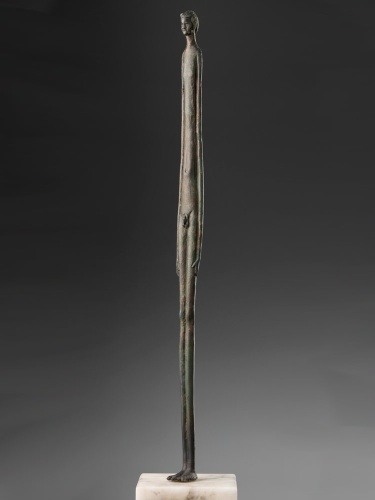
Thanks to rich local metal deposits, and contact with traders from Greece and the eastern Mediterranean, Etruscan production of bronze goods flourished. Even in antiquity, northern Etruscan cities were well known for their abilities to shape bronze into beautifully engraved hand-held mirrors, which were often decorated with scenes from Greek mythology, and votive statuettes, which were presented as offerings at sanctuaries and other sacred sites. However, it was not until the Classical period (c. 480-300 B.C.E.) that large-scale hollow-cast masterpieces – including perhaps the most famous Etruscan bronze, the Chimera of Arezzo (c. 375-350 B.C.E., Florence, Museum of Archaeology) – appeared. The curious elongated bronze figures of Volterra, including the Evening Shadow (c. 2nd century B.C.E., Volterra, Museo Etrusco Guarnacci), also began appearing during this era; these abstract votives would later inspire the early Italian tradition of board-like statuettes.
Grazie a depositi ricchi di metallo e il contatto con i mercanti della Grecia e del Mediterraneo orientale, la produzione delle merci di bronzo prosperava. In antichità, le città etrusche del nord erano famose per le loro abilità di plasmare bellissimi specchi incisi che ornavano spesso con scene della mitologia greca, e le statuine votive che offrivano ai santuari e ad altri luoghi sacri. Comunque, capolavori più grandi – come il bronzo etrusco più famoso, la Chimera d’Arezzo (c. 375-350 a.C., Firenze, Museo dell’Archaeologia) – non sono apparsi prima del periodo Classico (c. 480-300 a.C.). Durante quest’era, le curiose statuette allungate di Volterra, come l’Ombra della Sera (c. 200 a.C., Volterra, Museo Etrusco Guarnacci), hanno iniziato anche ad apparire; queste votive astratte hanno in seguito ispirato una tradizione italiana delle statuette schiacciate.
L’Ombra della Sera, ca. 200 a.C., Volterra, Museo Etrusco Guarnacci
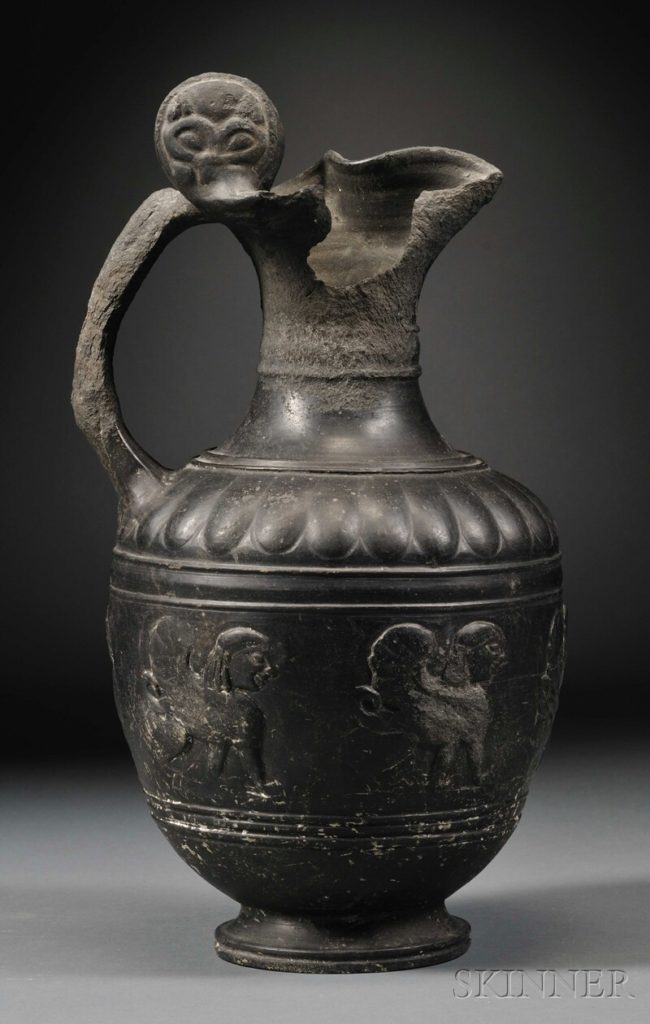
Bucchero, or “grey ware”, was developed in Ceveteri, as early as 675 B.C.E., and exported as far as Iberia and the Levant. This pottery was esteemed for its glossy dark grey to black finish, caused by the oxidation of the clay’s reddish ferric oxide while in the kiln. The forms that bucchero took are believed to have been inspired by both Greek pottery styles and contemporary metalwork, especially bronze. In addition to commonplace items like bowls, cups and jugs, bucchero was also shaped into cleverly designed vessels resembling animals, such as the cockerel of Viterbo. Most bucchero vessels were not decorated, but those that were embellished were incised or embossed with simple lines, geometeric patterns, motifs, and scenes from Greek mythology; some bucchero, in imitation of metalwork, were covered with gold or silver leaf, or with a thin layer of tin.
Bucchero si è sviluppato a Ceveteri circa 675 a.C., ed esportato fuori dell’Italia, alla penisola Iberica, al levante, e altre aree dell’Europa. Questa ceramica era pregiata per la sua lucida finitura nera, causata dell’ossidazione del rosso ossido ferrico nell’argilla. Le forme del bucchero s’ispiravano alle ceramice greche e ai metalli contemporanei, specialmente i bronzi. In aggiunta agli articoli usuali come le ciotole, le calici e le caraffe, bucchero veniva plasmato in recipienti ingegnosi che assomigliavano ad animali, come il galletto di Viterbo. La maggior parte del bucchero non è decorato, ma alcuni recipienti sono decorati con solchi semplici, disegni geometrichi, motivi, e scene di mitologia greca. Altri recipienti sono coperti con fogliame d’oro, di argento, o di latta per imitare i metalli.
Bucchero, Ceveteri, ca. 675 a.C
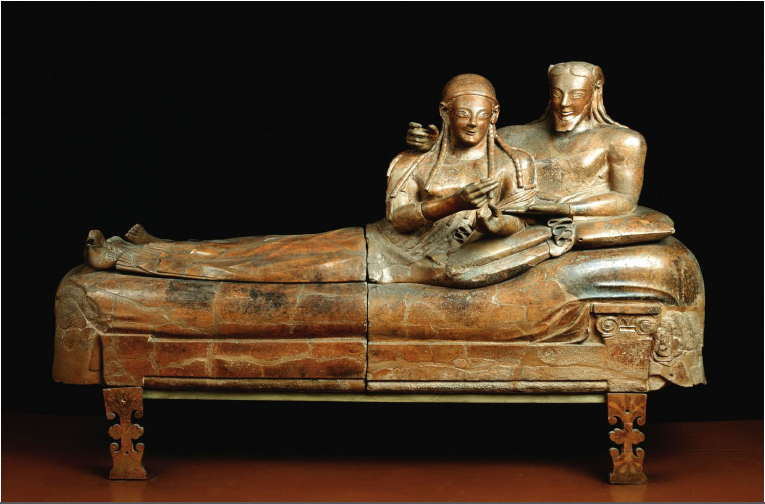
The Etruscans used sculpture primarily for funerary or religious purposes, including sarcophagi, ash urns and votive offerings made from terracotta, local stone such as alabaster, limestone, sandstone and tufa, and bronze. Beginning in the seventh century B.C.E., large stone and terracotta figures began appearing in tombs as either representations of tomb guardians, like those in the Tomb of Five Chairs in Cerveteri (c. 625-600 B.C.E.), or replacements for the bodies of the deceased, as seen in terracotta and bronze urns in Chiusi. Some painted terracottas, such as the Sarcophagus of the Spouses (c. 525-500 B.C.E., Rome, Villa Giulia Museum), offer some insight into the nature of everyday Etruscan life, as well as funerary rituals. The Sarcophagus of Spouses, which depicts a married couple reclining on a banqueting couch, once brightly coloured, suggests that Etruscan women were regarded with more significance than their Greek counterparts. In addition, the wineskin cushions upon which the couple lounges may be a reference to the sharing of wine, an important aspect of Etruscan funerary ritual; the woman also appears to be pouring something, perhaps perfume, into her husband’s palm, alluding to the offering of perfume, another essential element of the Etruscan funeral.
Gli etruschi usavano principalmente le sculture per scopi funerari o religiosi come i sarcofaghi, le urne e le offerte votive di terracotta, di pietra locale come alabastro, calcare, arenaria e tufo, e bronzo. Dal 700 a.C., grandi figure di pietra e terracotta cominiciavano ad apparire nelle tombe in veste di rappresentazioni dei guardiani delle tombe, come quelle nella Tomba di Cinque Sedie a Cerveteri (c. 625-600 a.C.), o come sostituzioni dei corpi dei defunti, come le urne di terracotta e bronzo a Chiusi. Qualche terracotta dipinta, come il Sarcofago degli Sposi (c. 525-500 a.C., Roma, Museo Villa Giulia), offre alcuni scorci della natura della vita ordinaria degli etruschi, e anche dei riti funerari. Il Sarcofago degli Sposi raffigura una coppia sposata su un divano banchetto, che suggerisce che le donne etrusche avevano maggiore importanza delle donne greche. Inoltre i cuscini [WINESKIN] sono probabilmente un riferimento alla condivisione di vino, che era un aspetto importante dei riti funerare. La donna sembra versare qualcosa, forse profumo, sul palmo della mano del marito; quest’azione allude all’offerta dei profumi, che era un’altra parte essenziale dei funerali etruschi.
Sarcofago degli Sposi, ca. 525-500 a.C., Roma, Museo Villa Giulia
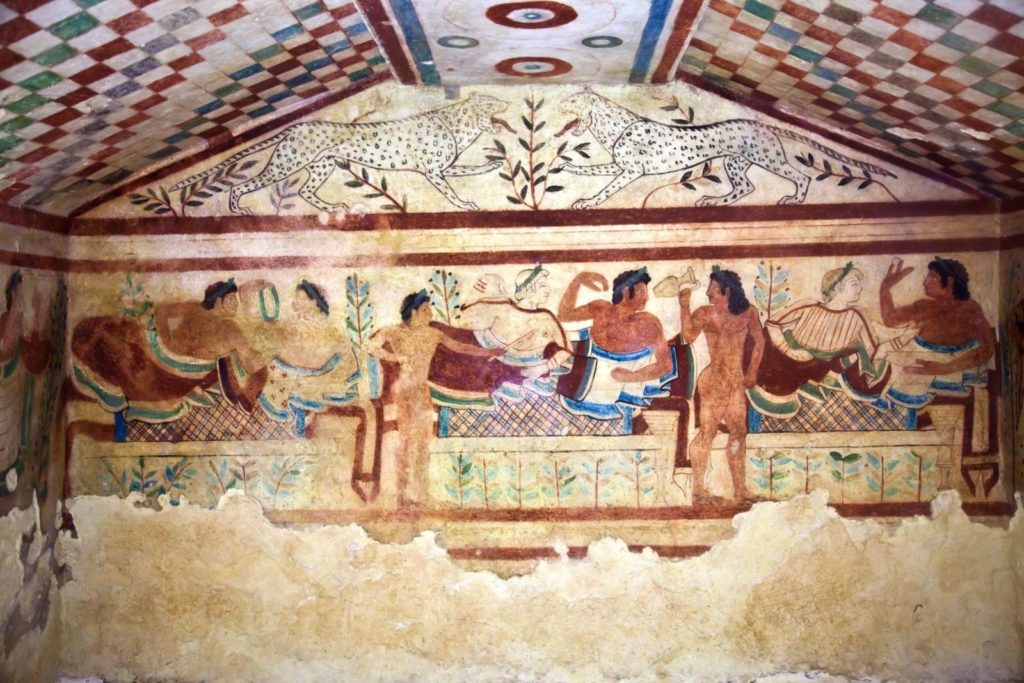
Many of the best examples of Etruscan painting were discovered in cemeteries, or necropoli, such as Monterozzi, near Tarquinia in Lazio, where huge works, depicting scenes of aristocratic life in Etruria, cover the interior walls of rock-cut chamber-tombs. One such tableau, found in the Tomb of the Lionesses in Monterozzi (c. 560 B.C.E.), illustrates a banquet, with dancers and musicians, and finely dressed nobles attended by naked servants. A second Monterozzi tomb painting, found in the Tomb of Hunting and Fishing (c. 510 B.C.E.), depicts a man hunting birds with what appears to be a slingshot, and a boat of fishermen casting a net. The murals of Monterozzi, along with a few other major centers, account for the largest surviving collection of wall paintings in the ancient world, outside of Egypt, Pompeii and Herculaneum.
Molti buoni esempi delle imbiancature etrusche sono state scoperte a necropoli, come Monterozzi vicino a Tarquinia nel Lazi, dove grandi imbiancature coprono le pareti delle tombe e mostrano scene della vita aristocratica in Etruria. Per esempio, un’imbiancatura nella Tomba delle Leonesse a Monterozzi (c. 560 a.C.) raffigura un banchetto con i ballerini, i musicisti, e i servi nudi che assistano gli aristocratichi. Una seconda imbiancatura a Monterozzi, nella Tomba della Caccia e della Pesca (c. 510 a.C.), raffigura un uomo che caccia gli uccelli con una fionda, e una barca con pescatori che gettano una rete. I murali di Monterozzi insieme a pochi altri centri importanti, sono considerati la più grande collezione di delle imbiancature del mondo antico fuori dall’Egitto, di Pompeii, e di Erculano.
Tomba delle Leonesse a Monterozzi, ca. 560 a.C.
When the Romans conquered the Etruscans in the late third century B.C.E., much of their culture disappeared as Etruscan nobles discarded their traditions for those of the dominant Greco-Roman society. However, the Etruscans also had a significant impact on Roman culture, as seen in the Roman adoption of Etruscan art, dress, music, and language. Today, the Etruscans survive in more than just museum collections; they survive in the artistic and cultural developments of their successors, and in the modern language that we know as Italian.
Quando i romani hanno conquistato gli etruschi nell’terzo secolo a.C., la maggior parte della loro cultura è morta, perché gli etruschi aristocratichi hanno abbandonato le loro tradizioni in favore di quelle della società greco-romana. Però, gli etruschi hanno avuto un’impatto significativo sulla cultura dei romani, che hanno adottato l’arte, i costumi, la musica e la lingua degli etruschi. Oggi, gli etruschi sono sopravvissuti non solo nelle collezioni dei musei; ma sono sopravvissuti negli sviluppi artistichi e culturali dei loro successori, e nella lingua moderna che conosciamo come la lingua italiana.
About the author:
Janine studies anthropology and history at university. She has a passion for the culture and the history of Italy, and she likes to share what she learns. He has been studying Italian with Mirella for several years. Some day she hopes to become a curator in a big museum in Europe, perhaps in beautiful Italy.
Janine studia antropologia e storia all’universita’. Ha una passione per la cultura e la storia d’Italia, e le piace condividere quello che impara. Studia l’Italiano con Mirella da parecchi anni. Qualche giorno spera diventare una curatrice in un museo grande in Europa, forse nella bella Italia.
Do you know how to use time schedules in Italian…or book a table at a restaurant, read opening and closing information at la pasticceria or il museo, etc.?
Also, did you know that “ferie” from the Latin word “feria” meaning holiday / party, while “feriale” means work day (from Monday to Friday)?
“Today’s use of the feminine plural noun “ferie” maintains the original meaning of ‘festive period, mostly summer rest’ .The weekday adjective (from the Latin ferialis) follows, semantically, the ecclesiastical calendar and indicates the days of the week not holidays (not dedicated to the celebration of the solemnity of Jesus or of Our Lady), therefore working days. In French, however, the ancient meaning has remained in the formula “jours fériés”, ‘holidays’.” via Accademia della Crusca
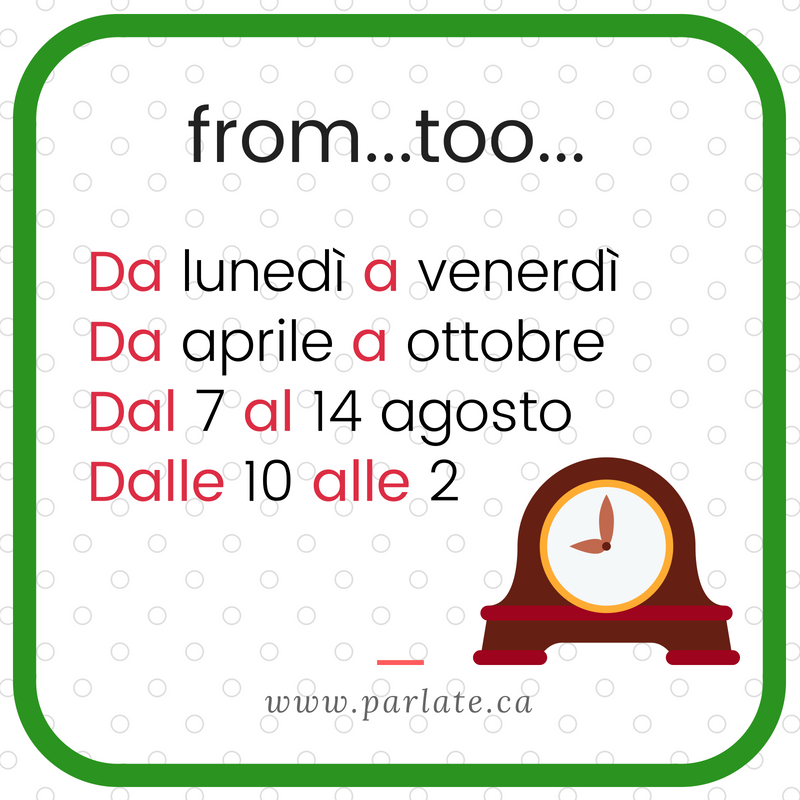
These situations all require the use of the prepositions ”da” and ”a” in the following cases:
Day
from Monday to Friday – Da lunedì a venerdì
Month
from April to October – da aprile a ottobre
Date
from the 7th to the 14 of August – dal 7 al 14 agosto
Time
from 10AM to 2PM – dalle 10 alle 14
Vocabolario:
giorno festivo – holiday
giorno feriale – weekday
chiuso – closed
aperto – open
giorno di chiusura – closed on…
orario – time schedule
orario estivo – summer schedule
orario invernale – winter schedule
pomeriggio chiuso – closed in the afternoon/lunchbreak
orario continuato – open in the afternoon/lunchbreak
Practice making appointments in the comments. Are there any other situations where you need to make an appointment in Italy?
Ricordo da bambina a casa dei nonni non mancava mai dopo il pranzo la tanto attesa domanda: “Mirella, lo vuoi il gelato?” seguita dai miei salti di gioia e la corsa verso la gelateria. I nonni, poverini, faticavano a starmi dietro!
Purtroppo tanti bambini non avevano e non hanno questa fortuna.
Quest’articolo parla di un’associazione italiana che regala gelati a bambini meno fortunati. Buona lettura, Mirella
p.s. Non perdere la prossima settimana la seconda parte di how to use “potere”
I remember when I was a child at my grandparents’ house, I never missed the long-awaited question after lunch: “Mirella, do you want ice cream?” followed by my leaps of joy and the rush to the ice cream shop. My grandparents, poor them, struggled to keep up with me! Unfortunately, many children did not have and do not have this luck.This article is about an Italian association that donates ice cream to less fortunate children. Enjoy, Mirella
A quale bambino non piace il gelato? Per molti bambini è il cibo più squisito – perfetto in una calda giornata estiva! Ma per alcuni bambini è una gioia della quale devono fare a meno perché le loro famiglie non possono permetterselo. Ma adesso, grazie a Salvamamme, un’associazione che aiuta le famiglie in situazioni difficili, questi bambini, meno fortunati, possono godersi un cono gustoso e rinfrescante.
What child doesn’t like ice cream? For many children it is the most scrumptious food – perfect on a hot sunny day! But for some children it is a joy they must do without because their families are not able to pay for it. But now, thanks to Salvamamme, an association that helps families in difficult situations, these less fortunate children can enjoy a tasty, refreshing cone.
Salvamamme è nata quasi venti anni fa. L’associazione risponde ai bisogni delle famiglie in crisi, intervenendo nei momenti cruciali e offrendo aiuto alle donne vittime di violenza. Per saperne di più su Salvamamme, vai al sito www.salvamamme.it.
Almost 20 years ago, Salvamamme was born. The association responds to the needs of families in crisis, intervening in crucial times and offering help to women victims of violence. To learn more about Salvamamme, go to the website www.salvamamme.it.
Nel 2015 Salvamamme ha avuto un’altra buon’idea. Sapeva che in estate, quando fa caldissimo, ci sono tanti bambini che chiedono ai genitori, “Posso avere del gelato?” Sfortunatamente, molte di queste famiglie, in una difficile situazione economica, non hanno i soldi per comprare un cono. Che delusione!
In 2015 Salvamamme had another good idea. They knew that in the summer, when it is very warm, there were many children that would ask their parents, “Can I have some ice cream?” Unfortunately, many of these families, in a difficult economic situation, did not have the money to buy a cone. What a disappointment!
L’idea geniale si basa su un’antica tradizione napoletana che si chiama “caffè sospeso” che significa un caffè in attesa. Dopo la seconda guerra mondiale, per esprimere solidarietà con quelli meno fortunati, quando una persona andava al bar a bere un caffè, ne pagava due e lasciava il secondo in “sospeso” per una persona che non aveva la possibilità di pagarlo. Quest’usanza si è diffusa attraverso l’Italia ed oggi è possibile regalare un caffè in molti bar italiani.
The brilliant idea is based on an ancient Neapolitan tradition that is called “caffè sospeso”which means “coffee in waiting.” After the Second World War, in order to express solidarity with those less fortunate, when a person went to the bar to have coffee, they would pay for two of them and would leave the second in “sospeso” for a person without the ability to pay for it. This custom spread across Italy and today it is possible to gift a coffee in many Italian bars.
E quindi è nata l’idea del gelato “sospeso”. Oggigiorno dal 1 giugno fino al 31 ottobre, quando compri un gelato per te o per i tuoi bambini, puoi lasciarne uno in “sospeso” per un bambino meno fortunato. Sul bancone della gelateria c’è un vaso di vetro dove puoi lasciare l’offerta. Accanto al vaso c’è una locandina che dice, “Noi aderiamo alla campagna gelato sospeso. Lascia pagato a un bambino un gelato.” Sono tantissime gelaterie in tutte le regioni italiane che partecipano a questo progetto generoso. Dal 2015 al 2017 sono stati donati più di 100.000 gelati!
And so the idea of ice cream “sospeso” was born. Nowadays from June 1 until the 31st of October, when you buy an ice cream for yourself or for your children, you can leave one in “sospeso” for a child less fortunate. On the counter of the ice cream shop there is a glass jar where you can leave the offering. Next to the jar there is a little poster that says, “We enroll in the ‘gelato sospeso’ campaign. Leave an icecream paid for, for a child.” There are a great many ice cream shops in all the Italian regions that participate in this generous project. From 2015 to 2017 more than 100,000 ice creams have been donated!
Se vai in Italia quest’estate e hai voglia di un gelato, fai attenzione a questi vasi trasparenti. È un’opportunità di donare un gelato, ma anche un sorriso. Troverai le gelaterie aderenti al progetto al sito www.gelatosospeso.it Ci vuole poco per rendere felice un bambino e scommetto che ti sentirai molto felice, anche tu.
If you are going to Italy this summer and you have the desire for an ice cream, look for these transparent jars. It is an opportunity to donate an ice cream but also a smile. You will find the ice cream shops that are enrolled in the project at the site www.gelatosospeso.it. It doesn’t take much to make a child happy and I will bet that you too will feel very happy!
Condividi quest’articolo con i tuoi amici così la prossima volta che andranno in Italia anche loro potranno regalare un gelato sospeso!
Share this article with friends so the next time they go to Italy they can donate un gelato sospeso!
*Le informazioni in quest’articolo sono state raccolte dal podcast “Al dente 138 (20 luglio 2018) e dal sito www.gelatosospeso.it
About the author: Linda Caprio Cooper is an Italian-american with a great passion for her Italian heritage who has been studying Italian with Mirella for over 2 years. She enjoys writing short stories in Italian and exploring the Italian language and culture.
A challenge for many Italian students is learning how to use tutto, tutti, tutta, tutte correctly. This simple explanation will help you master them.
There’s a quiz waiting for you to make sure that è tutto chiaro, everything is clear.
A challenge for many Italian students is learning how to use tutto, tutti, tutta, tutte correctly. This simple explanation will help you master them.
There’s a quiz waiting for you to make sure that è tutto chiaro, everything is clear.
1. “Tutto” by itself means “everything” • Tutto andrà bene. (Everything is going to be alright.) • Ho fatto tutto. (I did everything.)
2. Tutto/tutta in front of nouns mean “the whole…”, “the entire…” • Abbiamo mangiato tutta la torta. (We ate the whole cake.) • Abbiamo trascorso tutto il mese insieme. (We spent the whole month together.) • Hai visto tutta la partita? (Did you see the whole match?)
3. Tutti by itself means “everyone”/”everybody” • Tutti vanno in spiaggia durante l’estate. (Everyone goes to the beach during the summer.) • Ho comprato regali per tutti. (I bought gifts for everyone.)
4. Tutti/tutte (followed by a noun) mean “all of (something)” or even “every one of (something)” • Ho visto tutti i film di Fellini. (I’ve seen all of Fellini’s films.) • Luca ha parlato con tutte le ragazze della festa . (Luca talked to all of the girls at the party.) • Tutti i giorni studio in biblioteca. (I study at the library every day.)
Also, remember that tutto/tutti is masculine (singular/plural) and tutta/tutte is feminine (singular/plural).
Now you’re ready for the quiz!
Tutto chiaro? Try the quiz
Time limit: 0
Quiz-summary
0 of 8 questions completed
Questions:
1
2
3
4
5
6
7
8
Information
Inizia il quiz!
You have already completed the quiz before. Hence you can not start it again.
Quiz is loading...
You must sign in or sign up to start the quiz.
You have to finish following quiz, to start this quiz:
Results
0 of 8 questions answered correctly
Your time:
Time has elapsed
You have reached 0 of 0 points, (0)
Average score
Your score
Categories
Not categorized0%
Ottimo lavoro!
1
2
3
4
5
6
7
8
Answered
Review
Question 1 of 8
1. Question
1 points
T___ andrà bene.
Correct
Incorrect
Question 2 of 8
2. Question
1 points
Hai letto t____ il libro?
Correct
Incorrect
Question 3 of 8
3. Question
1 points
Angelo mangia sempre t_____ la sua pappa.
Correct
Incorrect
Question 4 of 8
4. Question
1 points
T_____ sono andati a sciare questo fine settimana.
Correct
Incorrect
Question 5 of 8
5. Question
1 points
T_____ le domeniche vado a pranzo dai nonni.
Correct
Incorrect
Question 6 of 8
6. Question
1 points
Metterò in ordine t_____!
Correct
Incorrect
Question 7 of 8
7. Question
1 points
Sabato vado sempre al supermercato e faccio t_____ la spesa per la settimana.