Do you know what the origins of the words Papa and Papà are? Today we’re going to find out as we celebrate Father’s Day which is observed on San Giuseppe (St. Joseph), on March 19. This year I am especially happy to celebrate it here in Italy with my father.
The words Papa and papà look the same, but Papa means Pope and papà means dad.
If we take a closer look we’ll see that the Papa lives in Rome, while my papà lives among his grapevines in Molise.
However, the word Papa takes us back to the Latin word Papa, which in turn comes from the Greek word Papas meaning father, padre in Italian, or papà, used in a more familiar and endearing way.
When there’s an accent mark on the vowel “a”, it is stressed like in the word papà, also in:
città attività libertà volontà bontà felicità
And this brings us to the conclusion that every papà is a Papa… 😉
Qual è secondo te la parola più famosa della lingua italiana? L’abbiamo sentita cantata tante volte da Dean Martin in “That’s Amore“. Gli italiani la stra-usano ad ogni occasione: “queste scarpe sono un amore”, “quel ragazzo/a è un amore”, “questa canzone è un amore”,… e così via.
Un’inguaribile romantica come me la usa non solo per chiamare tutti i gatti del quartiere, ma anche i suoi amici. Non credo che sia necessario un limite all’uso, anzi, più esprimiamo sentimenti di amore, più stiamo meglio tutti.
L’amore si accompagna sempre ad altre parole e gesti che ne danno il vero significato. In questo video ho compilato una lista di quelle che considero le più importanti.
gioia – joy
fiducia – trust
rispetto – respect
onestà – honesty
stima – praise
sostegno – support
pazienza – patience
creatività – creativity
Questo video è un amore… Una e-card da condividere con tutte le persone che ami.
Per concludere in dolcezza, Febbraio è un mese romantico e anche ricco di peccaminosi dolci di Carnevale. Non ho resistito e ho creato questa golosità. Sapete come si chiama?
Con tanto amore,
Mirella
Whatdo you think isthe mostfamousword of the Italian language? We’ve heard it sung so many timesby DeanMartinin“That’s Amore“. Italiansover use it at every opportunity: “queste scarpe sono un amore”, “quel ragazzo/a è un amore”, “questa canzone è un amore” (“these shoes are a love“, “the boy/girlis a love“, “this song is a love,”) …andso on.
A hopeless romanticlike myselfuses itnotonly to callall the cats in the neigborhood, but alsoher friends. I don’t thinkit’s necessary tolimitit’s use, on the contrary, the morewe expressfeelings of love, the more we areallbetter.
Loveis always accompanied byother wordsandgesturesthatgiveit its true meaning. Inthis video,I’vecompiled a list ofwhat I considerto be the most important ones.
gioia – joy
fiducia – trust
rispetto – respect
onestà – honesty
stima – praise
sostegno – support
pazienza – patience
creatività – creativity
This video is a love… questo video è un amore. An e-card to share with all the people you love.
To endon a sweet note, February is a month full of sinful Carnival sweets. I could not resist and I created this delicacy. Do you know what it’s called?
With lots of love,
Mirella
Join the ITALIANO ALLA MANO club for weekly study plans, learning materials and tips:
It’s well-known by now, “è risaputo ormai”, that Italians are the leaders not only in delicious food, fashion, cultural treasures, but also in expressing feelings, sensations, and opinions. From happiness to dissatisfaction and everything in between.
If you run into your Italian friend and ask her how she is doing, forget about “I’m good, and you?” for an answer, and instead, prepare for a detailed description of “vita, morte e miracoli”, as we say in Italian. If you don’t want to be labeled as “antipatico/a”, I suggest you follow along and do the same. At worst, “male che vada”, you might end up enjoying yourself “al bar”, at the coffee shop. And let’s be honest, going for your daily jog in the park and rushing to update your Facebook, Twitter, “e chi più ne ha più ne metta”, and so on and so forth status can wait anyway.
(Translation: “To listen. There is nothing better to do than to listen to someone who has something to say.”)
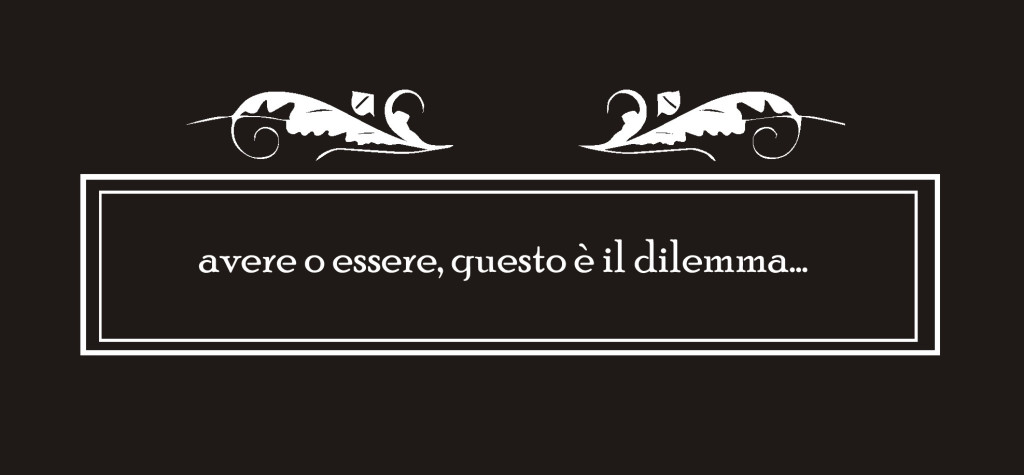
The best way to make a good impression, “fare una bella figura”, is to learn the most common idiomatic expressions in Italian that use “avere” (to have) and “essere” (to be), which, as many of you have complained “all’italiana” (Italian style), do not correspond to the English expressions. For example: “Io ho sonno” (I’m sleepy), “Io sono stanco” (I’m tired).
Avere + noun is used in many idiomatic expressions in Italian, but the equivalent English expressions are generally formed with essere + adjective.
There is no specific rule that explains this difference. The best advice is to:
first learn the conjugations of the verbs “essere” and “avere” starting with il “presente indicativo”
then learn each expression correctly
and as always practica, pratica, pratica!!
Here are some idiomatic expressions in Italian that use “avere” and “essere”.
“Avere” is used in the following expressions:
avere caldo – to be hot
avere freddo – to be cold
avere fretta – to be in a hurry
avere paura – to be afraid
avere bisogno di – to need
avere voglia di – to want, to feel like
avere a che fare con – to deal with
avere sete – to be thirsty
avere sonno – to be sleepy
avere fame – to be hungry
“Essere” is used in the following expressions (just like in English!):
essere stanco/a – to be tired
essere arrabbiato/a – to be angry
essere contento/a – to be happy
essere annoiato/a – to be bored
essere felice (m/f) – to be happy
essere triste (m/f) – to be sad
essere entusiasta (m/f) – to be enthusiastic
essere preoccupato/a – to be worried
essere in ritardo – to be late
essere testardo/a – to be stubborn
Allora, come sto?
Oggi sono felice e ho voglia di fare una passeggiata. Non ho freddo, perché è finalmente arrivata la primavera in Canada! Sono molto entusiasta!
(How am I? Today I am happy and I feel like taking a walk. I’m not cold, because spring has finally arrived in Canada! I’m enthusiastic!)
E tu come stai? Let me know in the comments below.
Remember there is no quick fix in learning idiomatic expressions… practice makes perfect!
Imagine learning lots of grammar and vocabulary only to discover that listeners find it hard to understand what you say…è terribile per la comunicazione! Also, if you can’t pronounce a word correctly, then you may not be able to hear it when spoken by another person either… ancora più terribile per la comunicazione!
This is a very common problem so don’t fret (non ti allarmare). I put together 7 solutions to improve your pronunciation based on my experience teaching Italian and learning languages.
In this post I’ll share my 1st tip: “Practice Italian with a flawless speaker!”
“Learning proper Italian from the start saves you time and frustration later correcting what you’ve learned incorrectly.”
It can sometimes be very difficult to correct what you’ve learned incorrectly as it turned out for my friend who had a teacher in elementary school that was very passionate about English, but was hardly proficient enough to teach simple words, such as “apple”, which sounded more like “apele” (similar to the word “ape”, “scimmia” in Italian), although she knew all the grammar. Till this day, over 20 years later, my friend still struggles to pronounce “apple” properly.
His English teacher, also a relative of mine in my little town, wanted to share her passion and land a job, but teaching is a serious matter. When I started teaching English in Italy, although I had reached the advanced level C2, according to the “Common European Framework of Reference for Languages: Learning, Teaching, Assessment”, I felt it would be fair to teach only levels A and B since I wasn’t speaking English on a daily basis and wouldn’t be able to teach successfully at a higher level.
Improvised language teachers are not a good deal!
So how do you know if a teacher speaks proper Italian?
Talk and listen to them a bit before jumping into it and, depending on whether the teacher is a native speaker or a non-native speaker, the pronunciation issues, if there are any, will differ.
I would ask both if they have any particular accents or regional intonation, hoping they’re aware and honest!
However, to be certain, I would go ahead and look out for more specific issues….
In the case of the native speaker pay attention to:
how they pronounce the grave or acute vowels such as in the words “verde” (the “e” is acute “vérde”), “cosa” (the “o” is grave “còsa”); “verde” correct:
“cosa” correct:
whether they tend to pronounce single consonants as double consonants instead; an example is “amore” sometimes mistakenly pronounced with a double “m” (the“o” is acute); “amore” correct:
whether they shorten the infinitives stressing the last vowel, like “mangià” instead of “mangiare”, “parlà”, instead of “parlare”, and so on;
While you’re at it, you can also check some grammar, which will give you a better idea of their speaking accuracy:
how they say: “I hope you are well.” (correct: “spero che tu stia bene”),
how they say: “Can you speak Italian?” (correct: “sai parlare l’italiano?” – not ‘puoi’ parlare l’italiano?”);
In the case of the non-native speaker, issues usually concern:
pronouncing the vowels,
stressing the words correctly,
pronouncing the “r”, the “t”, the “sch”, double consonants,
pronouncing the vowels at the end of the words and pronouncing them correctly (they are not all acute, only the ones with accents on them).
A way to verify that they are flawless speakers is to find a short audio snippet and ask them to repeat it. You can find excellent and reliable audio from Italian language manuals.
“Speaking properly is a form of respect for a language.”
Let me know in the comments below what your experience has been learning Italian.
Stay tuned for my next tip about my favourite language sharpener!
Chi lavora con le sue mani è un lavoratore. Chi lavora con le sue mani e la sua testa è un artigiano. Chi lavora con le sue mani e la sua testa ed il suo cuore è un artista. ~ San Francesco D’Assisi
He who works with his hands is a laborer. He who works with his hands and his head is a craftsman. He who works with his hands and his head and his heart is an artist. ~ St. Francis of Assisi
Buona festa del Papà to my father, a hard worker, a craftsman and an artist.
March 19 is St. Joseph (San Giuseppe) in Italy where it is celebrated as Father’s Day because San Giuseppe was un uomo e padre fantastico! A man that talked little and worked a lot, respected women, escaped oppression, followed his dreams, and provided for his childrens’ future.
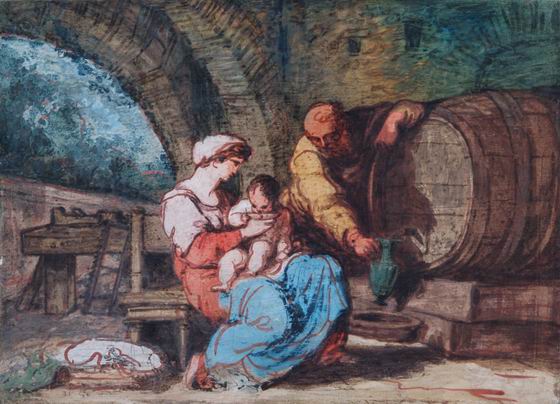
In the painting Felice Giani humanizes the religious theme of the Holy Family where St. Joseph in his carpenting shop lovingly fills a jug of wine from a large barrel. In the background you can see his work table on which lay his working tools.
San Giuseppe is a role model. A man who interprets the messages of his dreams and puts them into action. He first marries his girlfriend who is pregnant of a child that is not his own, sheltering them from contempt and a merciless punishment. He then carries out his second dream. He emigrates to a foreign land to escape the rule of a tyrant, and thus saves the future of his child. At last, after having rasied and taught his son a job, he realizes that at twelve years of age he is capable of dealing with the alleged wise men of the country. At this point his tasks are complete and he retires to the sidelines without honors or rewards. With a father like that no wonder (non cè da meravigliarsi) Gesus became a hero!
It may also be that San Giuseppe taught him the importance of languages and communication which I’m sure came in very handy as the saviour (il salvatore).
When my father emigrated to Canada he actually learned how to speak English fairly well compared to his brothers, setting an example for his children about the importance of learning and improving.
And talking about hard work…I know that when it comes to languages lots of work is required including tongue-twisters (scioglilingua), a useful tool to improve pronunciation and fluency. So here’s a popular Italian tongue-twister…at two different speeds.
How fast can you say it without stumbling?
Sopra la panca la capra campa, sotto la panca la capra crepa.
Allora, come si usa il verbo piacere? E’ una domanda che ricevo spesso. Credo che sia una buona idea rivedere come usare il verbo “piacere”, e verbi simili come “mancare” “servire”, “interessare”, ecc.
Per esempio, in italiano “mancare” può essere usato in diversi modi con vari significati. Vedremo il caso in cui significa “desiderare” indicando impazienza per qualcosa.
In questo caso segue una costruzione particolare che è comune anche ad altri verbi come “piacere” (vedi l’elenco sotto): ciò che ci piace è il soggetto mentre la persona che esprime apprezzamento diventa un pronome indiretto.
Mi (pronome indiretto) manca (verbo) l’Italia (soggetto). Mi manca l’Italia.
È importante prendersi un momento per ripassare i pronomi indiretti e ricordare dove sono inseriti in una frase. Vedi la scheda in basso. Esistono 2 forme di pronomi indiretti: forma atona e forma tonica. La forma tonica è solitamente usata per enfatizzare.
So, how is the verb “piacere” used? It’s a question I get often. I think it’s a good idea to review how to use the verb “piacere”, and similar verbs like “mancare”, “servire”, “interessare”, etc.
In Italian “mancare” can be used in several ways with various meanings. We’ll learn how to use it when it means “to miss/to long for”, indicating impatience for something.
In this case it follows a particular construction that is also common to other verbs such as “piacere” (see list below): what we like is the subject while the person who expresses appreciation is expressed with an indirect object pronoun.
Mi (indirect object pronoun) manca (verb) l’Italia (subject). I miss Italy.
It’s important to take a moment to review the indirect object pronouns and to remember where they are placed in a sentence. See the chart below. There are 2 forms of indirect object pronouns: forma atona and forma tonica. The forma tonica is usually used for emphasis.
SINGULAR forma atona
SINGULAR forma tonica
before the verb
before/after the verb
mi (to/for) me
a me (to/for) me
ti (to/for) you
a te (to/for) you
gli (to/for) him
a lui (to/for) him
Le/le (to/for) you (formal m. and f.)
a Lei/a lei (to/for) you (formal m. and f.)
PLURAL forma atona
PLURAL forma tonica
before the verb
before/after the verb
ci (to/for) us
a noi (to/for) us
vi (to/for) you
a voi (to/for) you
gli (to/for) them
a loro (to/for) them
Ricorda:
– Il verbo essere è l’ausiliare al passato prossimo: “Mi sono mancati i miei amici”. oppure “I miei amici sono mancati a me”. – Il verbo mancare è singolare se seguito da un infinito: “Mi manca mangiare gli spaghetti”. – A seconda della forma di pronome indiretto che stai utilizzando, la posizione dell’oggetto e del soggetto può essere invertita: “Mi manca l’Italia” o “L’Italia manca a me”.
Remember: – The verb essere is used as the auxiliary in the passato prossimo tense: “Mi sono mancati i miei amici.” or “I miei amici sono mancati a me”. – The verb mancare is singular when followed by an infinitive: “Mi manca mangiare gli spaghetti”. – Depending on which form of indirect pronoun you are using, the position of the object and the subject can be inverted: “Mi manca l’Italia” or “L’Italia manca a me.”
Un elenco di altri verbi che seguono la stessa regola:
A list of other verbs that follow the same rule:
piacere – to like, to be pleasing bastare – to be sufficient attrarre – to attract occorrere – to need succedere – to happen restare – to remain servire – to serve interessare – to interest disgustare – to disgust parere – to appear sembrare – to seem volerci – to take
Ecco un esercizio per fare fare pratica e non diemnticare di scrivere delle frasi nei commenti!
Here’s an exercise to help you practice and don’t forget to write some sentences in the comments!
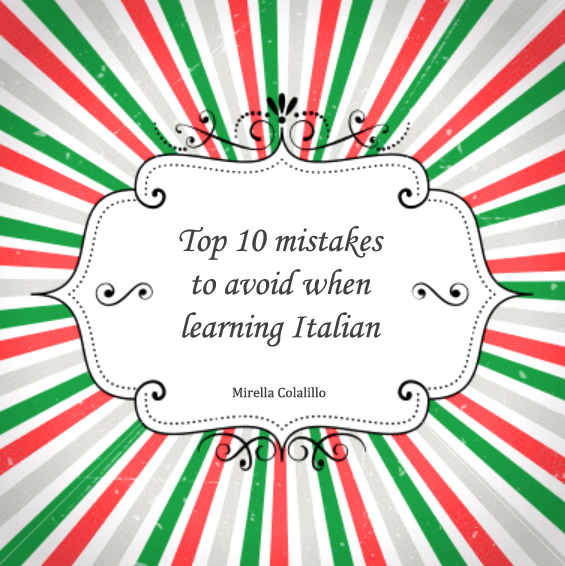
I was inspired to write this handy little guide to help students improve the quality of their Italian learning practice. It is the fruit of my experience teaching Italian and English as a second language for over 10 years, and learning 4 languages during and after my bachelor’s degree in linguistics.
I’ve listed the 10 most common mistakes that I’ve noticed students make when they’re learning Italian. It might be the first time you’re exploring a second language, and you’re not sure what it entails, especially with a fascinating and complex language such as Italian. Perhaps you’ve been studying for a while and you feel that you are not advancing as much as you wish to. In this case, if any of the mistakes listed are true for you, then you’ll soon be back on track, as I’ve also added some tips to help you avoid or overcome il problema.
So whether you are starting from scratch or you need to refocus, I hope this guide encourages you to stay motivated and helps spark renewed passion in your viaggio della lingua italiana.
Non aspettare, don’t wait, subscribe to Una Parola Al Giorno newsletter by and you’ll receive the free e-book, “Top 10 Mistakes To Avoid When Learning Italian”.