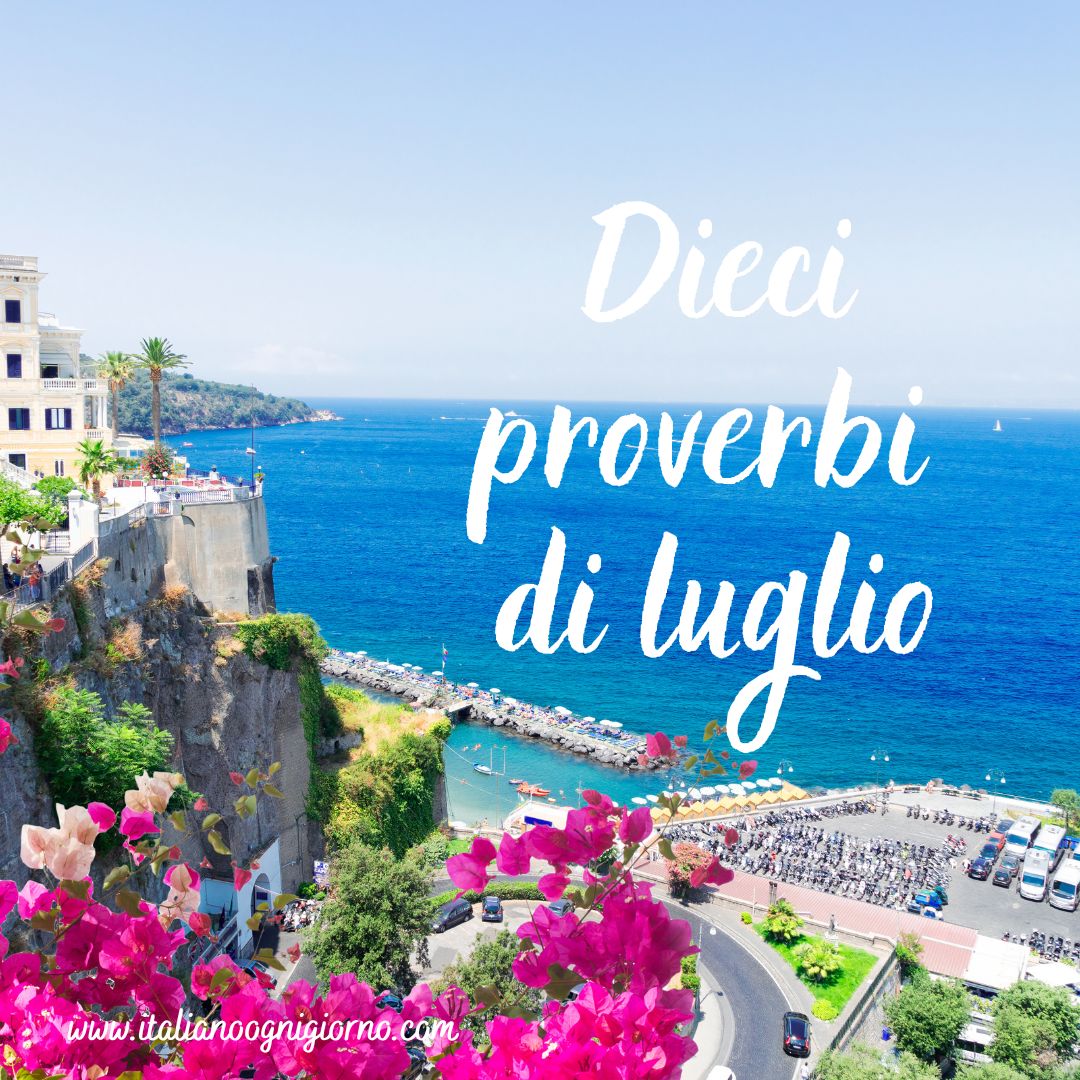
Sapevate che gli antichi Romani hanno dedicato il mese di luglio a Giove per l’abbondanza di frutta, verdura e cibo?
E inoltre il nome luglio, “Iulius” in latino, deriva da Giulio Cesare essendo nato intorno alla metà del mese di luglio dell’anno 101 a.C. Prima di essere dedicato al primo imperatore romano da Marco Antonio, questo bel mese estivo si chiamava “Quintilis”, poiché era il quinto mese dell’anno nel calendario di Romolo.
Non c’è da stupirsi che luglio abbia tanti detti e proverbi sopratutto legatiall’agricoltura e alla saggezza dei nostri antenati. Vediamone insieme dieci. Nel video ho incluso brevi clip di undici magnifiche località italiane.
Guarda il video:
Quando luglio è molto caldo, bevi molto e tienti saldo.
significato: Fa caldissimo a luglio sia di notte che di giorno, quindi idratarsi e stare al fresco e indispensabile!
Quando piove a luglio, ti viene il batticuore.
significato: Le piogge esaltano i profumi e la natura tutta attorno risvegliando i nostri sensi e i nostri cuori.
Se luglio gran calura, a gennaio gran freddura.
significato: Se fa molto caldo a luglio si prevede un gennaio molto freddo.
Il mattino scuro di luglio non significa brutta giornata.
significato: Anche se la giornata inizia nuvolosa è molto probabile che il sole spunterà.
Luglio con sacco e staio – porta i chicchi nel granaio.
significato: Nel mese della mietitura il sacco si riempie di chicchi di grano.
Di luglio il temporale, dura poco e non fa male.
significato: A luglio i temporali vanno e vengono senza danni.
Non far tempeste, Luglio mio, sennò il mio vino addio.
significato: Le tempeste non fanno bene al raccolto che non riempiono le ceste d’uva.
Chi vuole un buon rapuglio, lo semini in luglio.
significato: Chi vuole ottenere un’ottima coltivazione di rape è bene che faccia la semina in luglio.
Con luglio soleggiato il vino è assicurato.
significato: Un cielo soleggiato fa crescere l’uva in abbondanza.
Luglio poltrone, porta la zucca col melone.
significato: L’essenza del mese di luglio è racchiusa in questo proverbio, perché è un mese generoso di frutta e finalmente di meritato riposo.
English version
Did you know that the ancient Romans dedicated the month of July to Jupiter for its abundance of fruit, vegetables and food?
And furthermore the name July, “Iulius” in Latin, derives from Julius Caesar having been born around the middle of July in the year 101 BC. Before being dedicated to the first Roman emperor by Mark Antony, this beautiful summer month was called “Quintilis”, since it was the fifth (quinto) month of the year in Romulus’ calendar.
It is no wonder that July has so many sayings and proverbs especially related to agriculture and the wisdom of our ancestors. In the video I included short clips of eleven magnificent Italian locations.
Quando luglio è molto caldo, bevi molto e tienti saldo. – When July is very hot, drink a lot and hold your ground. meaning: It’s very hot in July both at night and during the day, so hydrating and staying cool is essential!
Quando piove a luglio, ti viene il batticuore. – Rain in July makes your heart beat. meaning: The rains enhance the scents and nature all around, awakening our senses and our hearts.
Se Luglio gran calura, a Gennaio gran freddura. – If July is very hot, January is very cold. meaning: If it is very hot in July, a very cold January is expected.
Il mattino scuro di luglio non significa brutta giornata. – The dark morning of July does not imply a bad day. meaning: Even if the day starts cloudy it is very likely that the sun will come out.
Luglio con sacco e staio – porta i chicchi nel granaio. – July with sack and bushel – take the grains to the barn. meaning:In the month of harvest the sack is filled with wheat grains.
Di luglio il temporale, dura poco e non fa male. – The storm in July is short time and causes no damage. meaning: In July, storms come and go without damage.
Non far tempeste, Luglio mio, sennò il mio vino addio. – Don’t make storms, my July, otherwise to my wine I’ll say goodbye. meaning: Storms are not good for the harvest as they do not fill the baskets with grapes.
Chi vuole un buon rapuglio, lo semini in luglio. – Those who want a good turnip crop should sow it in July. meaning: Those who want to obtain an excellent cultivation of turnips should sow in July.
Con luglio soleggiato il vino è assicurato. – With sunny July, wine is guaranteed; meaning: A sunny sky makes grapes grow in abundance.
Luglio poltrone, porta la zucca col melone. – Lazy July, brings pumpkins and melons. meaning: The essence of the month of July is contained in this proverb, because it is a generous month of fruit and finally of well-deserved rest
Summer of San Martino (Indian Summer) – legend and traditions
(English follows)
Capita quasi ogni anno, prima che faccia capolino l’inverno, chesi verifichi un’intervallo di bel tempo, con giornate luminose e tiepide nel pieno della stagione autunnale, nel periodo di fine ottobre-inizio novembre.
Un rialzo delle temperature mette in pausa pioggia, nebbia e freddo. Questo fenomeno avvolto da tradizioni e leggende di origine cristiana è conosciuto come l’Estate di San Martino.
La leggenda
“L’Estate di San Martino dura tre giorni e un pochino” è un popolare detto che accompagna la leggenda dell’Estate di San Martino, una tradizione popolare italiana che celebra la fine dell’estate e l’inizio dell’autunno.
Si narra che un freddo giorno d’autunno, molto probabilmente proprio l’11 novembre, Martino uscendo a cavallo da una delle porte della città di Amiens, in Francia, si è imbattuto in un uomo molto povero, nudo e infreddolito. San Martino ha avuto pietà dell’uomo e ha deciso di aiutarlo. Così ha tagliato il suo mantello di lana donandogli la metà.
Pare che dopo pochi istanti abbia smesso di piovere, sia spuntato il sole e la temperatura sia diventata più mite. Quella notte Martino ha sognato Gesù rivelando di essere lui il mendicante. Quindi per commemorare quell’11 novembre San Martino mantiene la sua promessa (quasi) ogni anno, regalando un’interruzione dalla morsa del freddo e un periodo piacevole e mite.
La tradizione
L’Estate di San Martino nei Paesi anglosassoni viene chiamata “Indian Summer” (letteralmente Estate Indiana) ed è nota anche nelle culture francofone e iberofone.
Questa festività in alcune parti d’Italia è associata alla vendemmia e alla raccolta delle olive. In effetti questa piccola pausa di piacevole clima è vista come un momento di transizione e cambiamento verso l’inverno che sta per arrivare.
Una spiegazione scientifica
L’Estate di San Martino ha anche una spiegazione scientifica. Secondo molti esperti l’alta pressione, le alte temperature e il bel tempo sono dovuti all’espansione dell’anticiclone dalla Spagna verso tutto il Mediterraneo.
San Martino, da militare a santo
Martino da Tours è nato intorno al 317 da una nobile famiglia. Si è convertito al cristianesimo dopo l’episodio del mantello ed è stato battezzato. Dopo vent’anni di carriera militare è diventato Vescovo di Tours nel 371. Ha fondato il monastero di Ligugé, il più antico d’Europa.
san martino nella letteratura
L’estate di San Martino è celebrata in diverse poesie e presta il nome anche al titolo di un romanzo. Ricordiamo:
una famosa poesia di Giosuè Carducci, intitolata appunto San Martino.
una poesia di Giovanni PascoliNovembre è dedicata all’Estate di San Martino
anche Cesare Pavese ha dedicato una poesia al periodo intitolata Estate di San Martino.
L’Estate di San Martino (Nachsommer, 1857) è uno dei romanzi più celebri di Stifter.
English version
It happens almost every year, before winter sets in, that there is an interval of good weather, with bright and warm days at the height of the autumn season, in the period from the end of October to the beginning of November.
A rise in temperatures puts a pause on rain, fog and cold. This phenomenon surrounded by traditions and legends of Christian origin is known as “L’Estate di San Martino”, Saint Martin’s Summer.
The legend
“Saint Martin’s Summer lasts three days and a little” (“L’Estate di San Martino dura tre giorni e un pochin) is a popular saying that accompanies the legend of Saint Martin’s Summer, an Italian popular tradition that celebrates the end of summer and the beginning of autumn.
It is said that one cold autumn day, most likely on November 11th, Martino, horse riding out of one of the gates of the city of Amiens, in France, came across a very poor, naked and cold man. Saint Martin took pity on the man and decided to help him. So he cut his woolen cloak and gave him half of it.
It seems that after a few moments it stopped raining, the sun came out and the temperature became milder. That night Martin dreamed of Jesus revealing that he was the beggar. So to commemorate that day of November 11th, Saint Martin keeps his promise (almost) every year, granting an interruption from the grip of the cold and a pleasant and mild period.
The Tradition
Saint Martin’s Summer in Anglo-Saxon countries is called “Indian Summer” and is also known in Francophone and Iberophone cultures.
This holiday in some parts of Italy is associated with the grape harvest and olive harvest. In fact, this small break of pleasant climate is seen as a moment of transition and change towards the winter that is about to arrive.
A scientific explanation
St. Martin’s Summer also has a scientific explanation. According to many experts, the high pressure, high temperatures and good weather are due to the expansion of the anticyclone from Spain towards the entire Mediterranean.
Saint Martin, from soldier to saint
Martin of Tours was born around 317 to a noble family. He converted to Christianity after the cloak episode and was baptized. After twenty years of military career he became Bishop of Tours in 371. He founded the monastery of Ligugé, the oldest in Europe.
Saint Martin in literature
The Estate di San Martino is celebrated in several poems and also lends its name to the title of a novel. We remember:
a famous poem by Giosuè Carducci, entitled San Martino.
a poem by Giovanni Pascoli Novembre is dedicated to the Summer of San Martino
Cesare Pavese also dedicated a poem to the period entitled Summer of San Martino. (Estate di San Martino)
St. Martin’s Summer (Nachsommer, 1857) is one of Stifter’s most famous novels.
Studiando l’italiano hai mai incontrato dei verbi seguiti da una preposizione e poi da un altro verbo all’inifinito o al gerundio? Sono dei verbi fraseologici e a volte ti fanno grattare il capo se non sai come usarli! Vediamo in particolare come si usano i verbi fraseologici venire a prendere e andare a prendere.
I verbi venire a prendere e andare a prendere sono chiamati verbi fraseologici. Sono usati davanti a un altro verbo all’infinito o al gerundio e sono spesso accompagnati da una preposizione.
I verbi fraseologici esprimono una particolare azione, per esempio: cominciare a +infinito – (inizio dell’azione) finire di + infinito – (fine dell’azione) continuare a +infinito – (proseguimento dell’azione) stare per + gerundio – (progressività dell’azione)
I verbi venire a + prendere e andarea + prendere indicano il movimento di un’azione.
Vediamo alcune frasi:
Venire a prendere – to come get, pick up
1. Vengo a prendere la mia bici domani quando sarà pronta.
2. Stasera i miei amici vengono a prendere dell’uva del mio orto.
3. Sono venuti a prenderci alla fermata dell’autobus.
4. Ti veniamo a prendere all’aeroporto.
Andare a prendere– to go get, pick up
1. Siete andati a prendere un caffè al bar?
2. Ogni giorno va a prendere la figlia all’uscita dalla scuola.
3. Sono andati a prendere le chiavi dell’appartamento.
4. Domani andremo a prendere del vino in cantina.
Consiglio
Quando hai dei dubbi, per non sbagliare, consulta sempre il dizionario!
Continua a esercitarti nell’Accademia dei Verbi. Troverai tanti esercizi efficaci che ti aiuteranno a coniugare tutti i tempi verbali e a pronunciarli bene:
English version
While studying Italian, have you ever encountered verbs followed by a preposition and then by another verb in the infinitive or gerund? They are phrasal verbs and sometimes they make you scratch your head if you don’t know how to use them! Let’s see in particular how to use the phrasal verbs venire a prendere and andare a prendere.
The verbs venire a prendere and andare a prendere are called phrasal verbs. They are used before another verb in the infinitive or gerund and are often accompanied by a preposition.
Phrasal verbs express a particular action, for example: cominciare a +infinito – (start of an action) finire di + infinito – (end of an action) continuare a +infinito – (continuation of an action) stare per + gerundio – (progression an action)
The verbs venire a + prendere e andarea + prendere indicate the movement of an action.
Let’s have a look at some sentences:
Venire a prendere – to come get, pick up
1. Vengo a prendere la mia bici domani quando sarà pronta. I’ll come get my bike tomorrow when it’s ready.
2. Stasera i miei amici vengono a prendere dell’uva del mio orto. Tonight my friends are coming to get some grapes from my garden.
3. Sono venuti a prenderci alla fermata dell’autobus. They came to pick us up at the bus stop.
4. Ti veniamo a prendere all’aeroporto. We will pick you up at the airport.
Andare a prendere– to go get, pick up
1. Siete andati a prendere un caffe al bar? Have you gone to and get a coffee at the bar?
2. Ogni giorno va a prendere la figlia all’uscita dalla scuola . Every day he goes to pick up his daughter from school.
3. Sono andati a prendere le chiavi dell’appartamento. They went to get the keys to the apartment.
4. Domani andremo a prendere del vino in cantina. Tomorrow we will go to the cellar to get some wine.
Suggestion:
When in doubt, to avoid making mistakes, always consult the dictionary!
Continua a esercitarti (continue to practice) in the Accademia dei Verbi. You will find many effective exercises that will help you conjugate all the verb tenses and pronounce them well:
Parole, parole, parole… come cantava Mina. Usare le parole italiane che già conosci e quelle che incontri leggendo, ascoltando musica o parlando con altri italiani, magari in Italia, è la cosa più importante per avanzare nella lingua parlata. Infatti, quando si impara una lingua l’obiettivo è riuscire a comunicare e conversare. Ecco a cosa servono le parole, i suoni, le espressioni… Vediamo come:
mantenere viva una conversazione senza interromperla
utilizzare parole di riempimento o intercalari
esprimere emozioni con interiezioni
mostrare apprezzamento per qualcosa
Parole, parole, parole… as Mina would sing. Using the Italian words you already know and those you come across while reading, listening to music or talking to other Italians, perhaps in Italy, is the most important thing to advance in the spoken language. In fact, when learning a language, the goal is to be able to communicate and converse. That’s what words, sounds, expressions are for… Let’s see how:
to keep a conversation going without interrupting
to use filler words
to express emotions with interjections
to show appreciation for something
Parole italiane per mantenere viva una conversazione
Esiste una categoria di parole ed espressioni che vengono usate per mantenere viva una conversazione. Queste parole ed espressioni aiutano anche a comunicare il nostro accordo, disaccordo e incertezza senza interrompere l’interlocutore. Ecco una lista di alcune delle più comuni.
There is a category of words and expressions that are used to keep a conversation going. These words and expressions also help communicate our agreement, disagreement, and uncertainty without interrupting the other party. Here is a list of some of the more common ones.
In italiano le ‘parole riempitive’ o ‘intercalari’ si usano in abbondanza, come potrai notare dalla lunga lista che ho compilato. Si possono dividere in 3 catogorie: iniziatori, mediani e finalizzatori. Anche se, diciamo che, alcune di queste parole o espressioni si prestano bene in diverse situazioni. Sono particolarmente importanti per dare fluidità ad una conversazione.
In Italian the ‘filler words’, “parole riempitive” o”intercalari” are used in abundance, as you can see from the long list I have compiled. They can be divided into 3 categories: starter words, middle words and ending words. Although, “diciamo”, let’s say that, some of these words or expressions lend themselves well in different situations. They are particularly important for giving fluidity to a conversation.
L’interiezione si usa per esprimere emozioni, stati d’animo e reazioni istintive condensate in una sola espressione, senza legami sintattici con il resto della frase.
The interjection is used to express emotions, moods and instinctive reactions condensed into a single expression, without syntactic links with the rest of the sentence.
Sai, che il proverbio “De gustibus non disputandum est” – Sui gusti non si discute, è uno dei più utilizzati dagli italiani? E comunque non viene utilizzato solo riguardo al cibo, bensi anche per ogni altro tipo di gusto: musica, moda, genere letterario ecc. Nell’articolo di questa settimana però restiamo nel campo del cibo e vediamo tutti i modi per dire “buonissimo” in italiano.
Do you know that the proverb “De gustibus non disputandum est”/ Sui gusti non si discute (there’s no accounting for taste) is one of the most used by Italians? And in any case it is not only used for food, but also for any other type of taste: music, fashion, literary genre, etc. In this week’s article, however, we remain in the field of food and look intl all the ways to say “very good” in Italian.
A volte basta una sola lettera pronunciata in modo errato per cambiare il significato di una parola. Prendiamo come esempio le due parole “rosa” e “rossa”. Con la prima indichiamo il fiore e, trovandosi tra due vocali, la “s” ha un suono sibilante come una “z” dolce. Mentre la seconda è un aggettivo di colore in cui la doppia “s” ha un suono forte. Quindi quando sentiamo “rosa rossa” notiamo la differenza nel suono della “s” il che ci permette di capire che parliamo di un fiore di colore rosso.
La lettera “s” ha 3 suoni particolari:
la doppia “ss“
la “s” che sembra “z”
la “s” normale (parole che iniziano con la “s” o la “s” è accanto ad una consonante
Ecco una lista di parole per esercitari.
Sometimes all it takes is one mispronounced letter to change the meaning of a word. Let’s take as an example, the two words “rosa” and “rossa”. With the first we indicate the flower and, being between two vowels, the “s” has a sibilant sound like a soft “z”. While the second is an adjective of color and the double “s” has a strong sound. So when we hear “rosa rossa” we notice the difference in the sound of the “s” which allows us to understand that we are talking about a red flower.
The letter “s” has 3 particular sounds:
la doppia “ss“/ the double “ss”
la “s” che sembra “z” / the “s” that sounds like “z”
la “s” normale (parole che iniziano con la “s” o la “s” è accanto ad una consonante / words starting with “s” or “s” is next to a consonant